Question
Through what potential difference should an electron be accelerated to give it a speed of:
  1. 0.6c
  2. 0.9c
  3. 0.99c

Answer

  1. $\text{eV}-\text{m}_0\text{C}^2=\frac{\text{m}_0\text{C}^2}{2\sqrt{1-\frac{\text{V}^2}{\text{C}^2}}}$
$\Rightarrow\text{eV}-9.1\times10^{-31}\times9\times10^{16}$

$=-\frac{9.1\times9\times10^{-31}\times10^{16}}{2\sqrt{1-\frac{0.36\text{C}^2}{\text{C}^2}}}$

$\Rightarrow\text{eV}-9.1\times9\times10^{-15}$

$=\frac{9.1\times9\times10^{-15}}{2\times0.08}$

$\Rightarrow\text{ev}-9.1\times9\times10^{-15}$

$=\frac{9.1\times9\times10^{-15}}{1.6}$

$\Rightarrow\text{eV}=\Big(\frac{9.1\times9}{1.6}+9.1\times9\Big)\times10^{-15}$

$=\text{eV}\Big(\frac{81.9}{1.6}+81.9\Big)\times10^{-15}$

$=\text{eV}=133.0875\times10^{-15}$

$\Rightarrow\text{V}=83.179\times10^{4}=831\text{KV}$
  1. $\text{eV}=\text{m}_0\text{C}^2=\frac{\text{m}_0\text{C}^2}{2\sqrt{1-\frac{\text{V}^2}{\text{C}^2}}}$
$\Rightarrow\text{eV}-9.1\times9\times10^{-19}\times9\times10^{16}$

$=\frac{9.1\times9\times10^{-15}}{2\sqrt{1-\frac{0.81\text{C}^2}{\text{C}^2}}}$

$\Rightarrow\text{eV}-81.9\times10^{-15}=\frac{9.1\times9\times10^{-15}}{2\times0.435}$

$\Rightarrow\text{eV}=12.237\times10^{-15}$

$\Rightarrow\text{V}=\frac{12.237\times10^{-15}}{1.6\times10^{-19}}=76.48\text{kV}$

$\text{V}=0.99\text{C}=\text{ev}-\text{m}_0\text{C}^2=\frac{\text{m}_0\text{C}^2}{2\sqrt{1-\frac{\text{V}^2}{\text{C}^2}}}$

$\Rightarrow\text{eV}=\frac{\text{m}_0\text{C}^2}{2\sqrt{1-\frac{\text{V}^2}{\text{C}^2}}}+\text{m}_0\text{C}^2$

$=\frac{9.1\times10^{31}\times9\times10^{16}}{2\sqrt{1-(0.99)^2}} +9.1\times10^{-31}\times9\times10^{16}$

$\Rightarrow\text{eV}=372.18\times10^{-15}$

$\Rightarrow\text{V}=\frac{372.18\times20^{-15}}{1.6\times10^{-19}}=272.6\times10^{4}$

$\Rightarrow\text{V}=2.726\times10^{6}=2.7\text{MeV}$

Need a full question paper?

Generate a complete, print-ready paper with questions like this in minutes — across 16+ boards, with answer keys.
Start Generating Free

Similar questions

A ball is thrown upward with an initial velocity of $100m/s$. After how much time will it return? Draw velocity$-$time graph for the ball and find from the graph.
  1. Maximum height attained by ball.
  2. Height of the ball after $15s$. Take, $g = 10ms^{-2}$
Two charges $2.0 \times 10^{-6}C$ and $1.0 \times 10^{-6}C$ are placed at a separation of 10cm. Where should a third charge be placed such that it experiences no net force due to these charges?
The earth has a radius of $6400km$. The inner core of 1000km radius is solid. Outside it, there is a region from $1000km$ to a radius of $3500km$ which is in molten state. Then again from $3500km$ to $6400km$ the earth is solid. Only longitudinal (P) waves can travel inside a liquid. Assume that the P wave has a speed of $8km s^{–1}$ in solid parts and of $5km s^{–1}$ in liquid parts of the earth. An earthquake occurs at some place close to the surface of the earth. Calculate the time after which it will be recorded in a seismometer at a diametrically opposite point on the earth if wave travels along diameter?
Consider a circular ring of radius r, uniformly charged with linear charge density $\lambda.$ Find the electric potential at a point on the axis at a distance x from the centre of the ring. Using this expression for the potential, find the electric field at this point.
Though the law gives women equal status in India, many people hold unscientific views on a woman’s innate nature, capacity and intelligence, and in practice give them a secondary status and role. Demolish this view using scientific arguments, and by quoting examples of great women in science and other spheres; and persuade yourself and others that, given equal opportunity, women are on par with men.
At what temperature is the root mean square speed of an atom in an argon gas cylinder equal to the rms speed of a helium gas atom at $-20°C$? (atomic mass of $Ar = 39.9u$, of $He = 4.0u$).
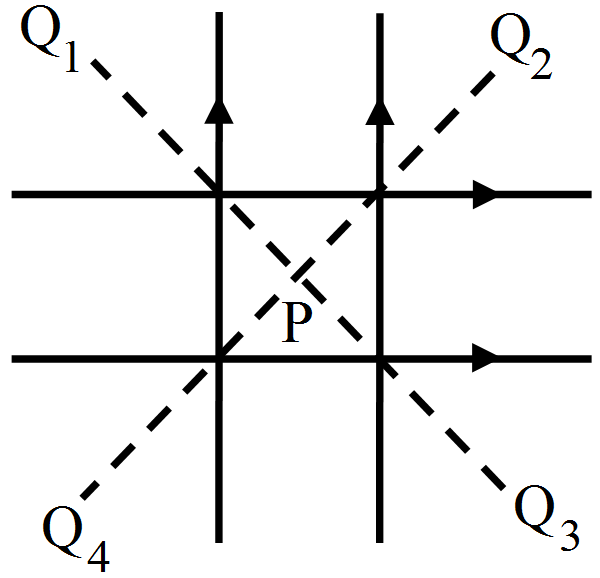
Four long, straight wires, each carrying a current of $5.0A$, are placed in a plane as shown in figure. The points of intersection form a square of side $5.0cm$.
  1. Find the magnetic field at the centre P of the square.
  2. $Q_1, Q_2, Q_3,$ and $Q_4$ are points situated on the diagonals of the liquare and at a distance from P that is equal to the length of the diagonal of the square. Find the magnetic fields at these points.
A disc of radius R is rotating with an angular speed $\omega_\text{o}$ about a horizontal axis. It is placed on a horizontal table. The coefficient of kinetic friction is $\mu_\text{k}{:}$
  1. What was the velocity of its centre of mass before being brought in contact with the table?
  2. What happens to the linear velocity of a point on its rim when placed in contact with the table?
  3. What happens to the linear speed of the centre of mass when disc is placed in contact with the table?
  4. Which force is responsible for the effects in (b) and (c).
  5. What condition should be satisfied for rolling to begin?
  6. Calculate the time taken for the rolling to begin.
A piano wire A vibrates at a fundamental frequency of 600Hz. A second identical wire B produces 6 beats per second with it when the tension in A is slightly increased. Find the ratio of the tension in A to the tension in B.
Show that a(b × c) is equal in magnitude to the volume of the parallelepiped formed on the three vectors a, b and c.