MCQ
Time periods of oscillation of the same simple pendulum measured using four different measuring clocks were recorded as $4.62 \mathrm{~s}, 4.632 \mathrm{~s}, 4.6 \mathrm{~s}$ and $4.64 \mathrm{~s}$. The arithmetic mean of these reading in correct significant figure is.
  • A
    $4.623 \mathrm{~s}$
  • B
    $4.62 \mathrm{~s}$
  • $4.6 \mathrm{~s}$
  • D
    $5 \mathrm{~s}$

Answer

Correct option: C.
$4.6 \mathrm{~s}$
c
Sum of number by considering significant digit sum $=4.6+4.6+4.6+4.6=18.4$

$\text { Arithmetic Mean }=\frac{\text { sum }}{4}=\frac{18.4}{4}=4.6$

Need a full question paper?

Generate a complete, print-ready paper with questions like this in minutes — across 16+ boards, with answer keys.

Start Generating Free

Similar questions

A pipe $30 cm$ long is open at both ends. Which harmonic mode of the pipe is resonantly excited by a $1.1 kHz$ source ? (Take speed of sound in air =$ 330 ms^{-1}$)
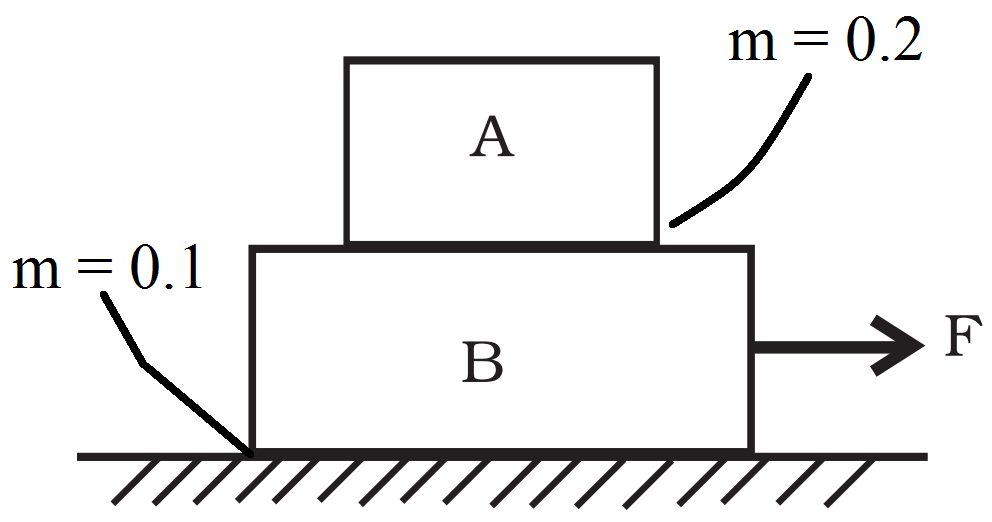
In the co$-$efficient of friction between the floor and the body $B$ is $0.1$ . The co$-$efficient of friction between the bodies $B$ and $A$ is $0.2 .$ A force $F$ is applied as shown on $B$. The mass of $A$ is $m / 2$ and of $B$ is $m$. Which of the following statements are true?
Three identical particle $A , B$ and $C$ of mass $100\, kg$ each are placed in a straight line with $AB = BC =13 \,m$. The gravitational force on a fourth particle $P$ of the same mass is $F$, when placed at a distance $13 \,m$ from the particle $B$ on the perpendicular bisector of the line $AC$. The value of $F$ will be approximately$....G$
When an ideal gas in a cylinder was compressed isothermally by a piston, the work done on the gas was found to be $1.5 \times {10^4}\;joules$. During this process about
The ratio of distances covered by a freely falling object in its first and second second is:
If Planck’s constant $(h)$ and speed of light in vacuum $(c)$ are taken as two fundamental quantities, which one of the following can, in addition, be taken to express length, mass and time in terms of the three chosen fundamental quantities?
$A.$ Mass of electron $(m_e).$
$B.$ Universal gravitational constant $(G).$
$C.$ Charge of electron $(e).$
$D.$ Mass of proton $(m_p).$
A particle moves in $x-y$ plane according to rule $x = {\rm{asin}}\omega t$ and $\;y = {\rm{acos}}\omega t$. The particle follows  
The isothermal bulk modulus of a perfect gas at normal pressure is
The law of conservation of energy means:
The heat engine with maximum efficiency is: