Question
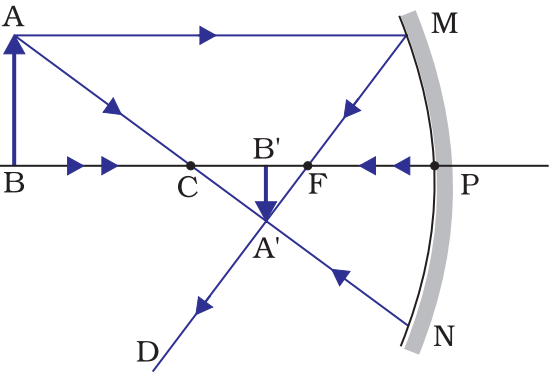
  1. To construct a ray diagram we use two light rays which are so chosen that it is easy to know their directions after reflection from the mirror. List these two rays and state the path of these rays after reflection. Use these two rays to locate the image of an object placed between infinity and the centre of curvature of a concave mirror.
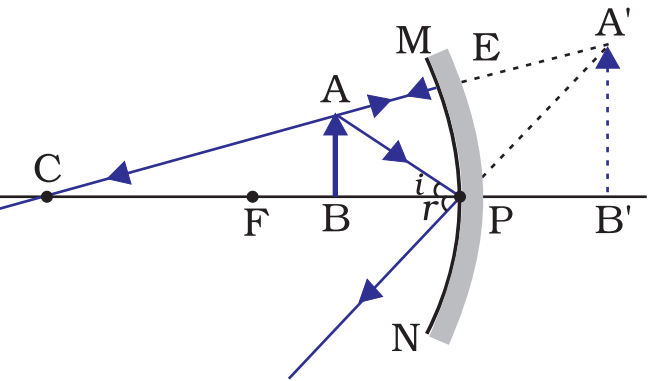
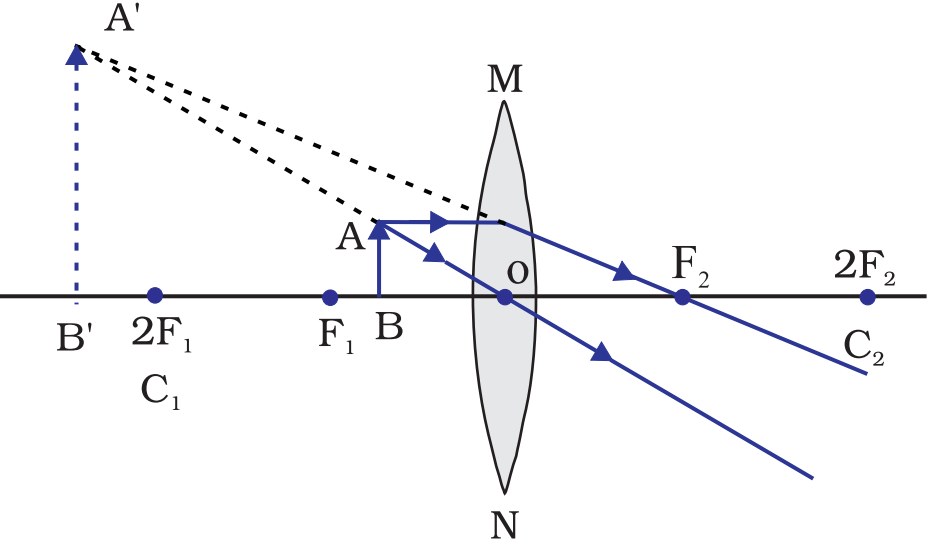
  2. Draw a ray diagram to show the formation of image of an object placed between the pole and principal focus of a concave mirror. How will the nature and size of the image formed change, if the mirror is replaced by a converging lens of same focal length?
Answer

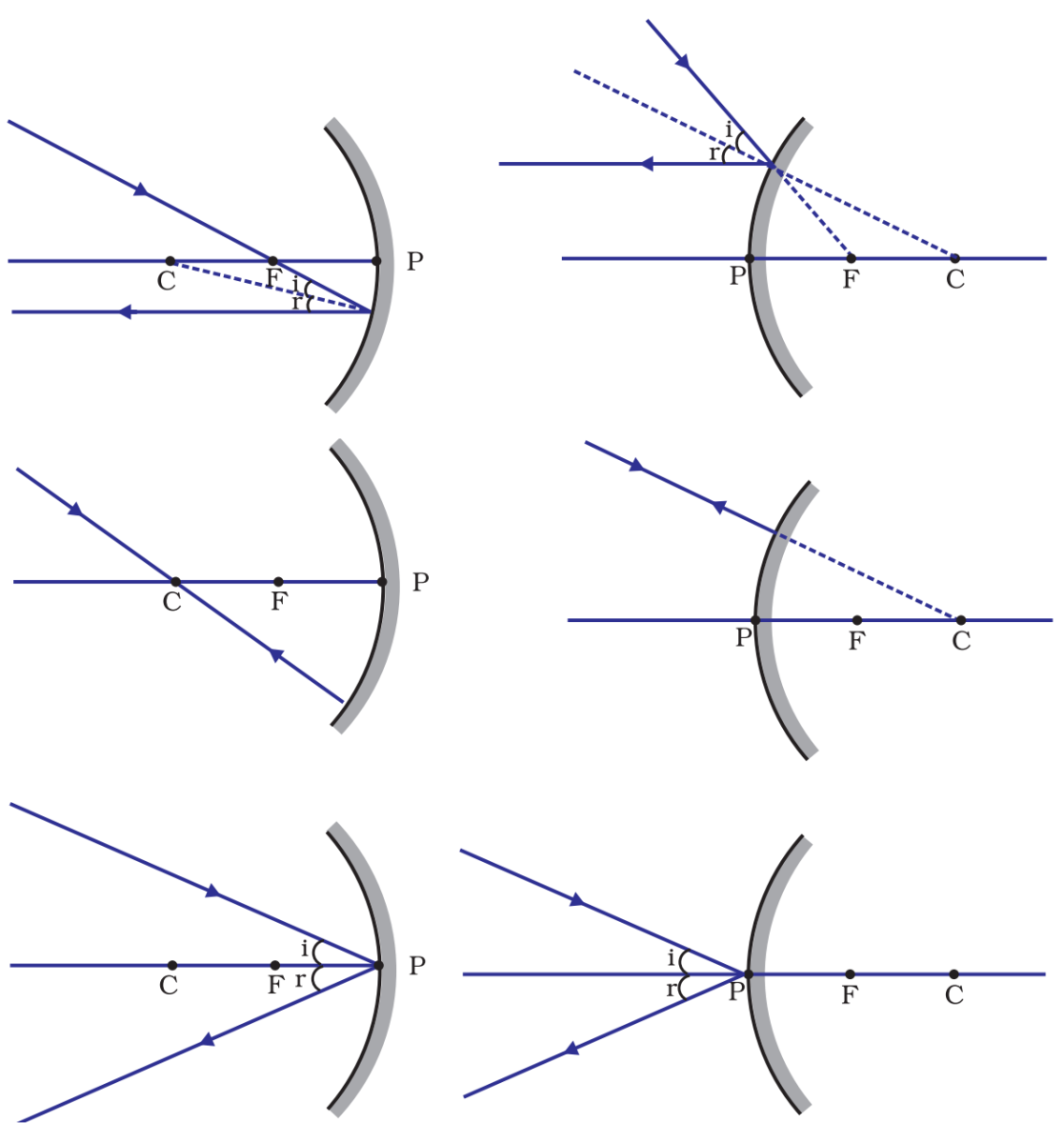
  1. The rays used for obtaining the image from the mirror after reflections are as follows:
  1. A ray which is parallel to the principal axis which on reflecting from the mirror, passes through the focus (when the mirror is concave) or appears to pass through the focus (in case of convex mirror).
  2. A ray which passes through the principal focus of the mirror is directed towards the principal focus , in case of convex mirror, it will emerge as parallel to the principal axis of the mirror.
  3. The Ray which passes through the center of curvature of concave mirror or directed in the direction of center of curvature of convex mirror, reflects back along the same path.
  1. The ray diagrams are as follows:


  1. When object is placed between infinity and C:


  1. When the object is placed between pole and focus of a concave mirror:


  1. When the object is placed between pole and focus of convex lens:

Need a full question paper?

Generate a complete, print-ready paper with questions like this in minutes — across 16+ boards, with answer keys.

Start Generating Free

Similar questions

List the sign conventions for reflection flight by spherical mirrors. Draw a diagram and apply these conventions in the determination of focal length of spherical mirror which forms a three times magnified real image of an object placed 16 cm infront of it.
A nuclear reaction is represented by the following equation:
$^{235}_{\ \ 92}\text{U}+{^{1}_{0}\text{n}}\rightarrow{^{139}_{\ \ 56}\text{Ba}}+{^{94}_{36}\text{Kr}}+\text{xc}+\text{E}$
  1. Name the process represented by this equation and describe what takes place
  2. Identify the particle c and the number x of such particles produced in the reaction.
  3. What does E represent?
  4. Name one installation where the above nuclear reaction is utilised.
  5. What type of bomb is based on similar type of reaction?
If a concave mirror has a focal length of 10cm, find the two positions where an object can be placed to give, in each case, an image twice the height of the object.
Two lamps, one rated 40W at 220V and the other 60W at 220V, are connected in parallel to the electric supply at 220V.
  1. 10 Draw a circuit diagram to show the connections.
  2. Calculate the current drawn from the electric supply.
  3. Calculate the total energy consumed by the two lamps together when they operate for one hour.
State Ohm’s law? How can it be verified experimentally? Does it hold good under all conditions? Comment.
State the laws of refraction of light. Write an expression to relate absolute refractive index of a medium with speed of light in vacuum.
The refractive index of a medium x with respect to y is $\frac{2}{3}$ and the refractive index of medium y with respect to z is $\frac{4}{3}$ Calculate the refractive index of medium z with respect to medium x
Explain the structure and functioning of Human eye. How are we able to see nearby as well as distant objects?
A wire is cut into three equal parts and then connected in parallel with the same source. How will its.
  1. Resistance and resistivity gets affected?
  2. How would the total current and the current through the parts change?
  1. List the parts of the human eye that control the amount of light entering into it. Explain how they perform this function.
  2. Write the function of retina in human eye.
  3. Do you know that the corneal-impairment can be cured by replacing the defective cornea with the cornea of the donated eye? How and why should we organise groups to motivate the community members to donate their eyes after death?
The variation of image distance (v) with object distance (u) for a convex lens is given in the following observation table. Analyse it and answer the questions that follow:
S.NO.Object distance (u) cmImage distance (v) cm
1-150+30
2-75+37.5
3-50+50
4-37.5+75
5-30+150
6-15+37.5

i. Without calculation, find the focal length of the convex lens. Justify your answer.
ii. Which observation is not correct? Why? Draw ray diagram to find the position of the image formed for this position of the object.
iii. Find the approximate value of magnification for $u=-30 \mathrm{~cm}$.