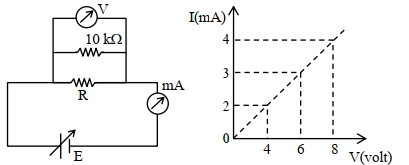
To determine the resistance ($R$) of a wire, a circuit is designed below, The $V-I$ characteristic curve for this circuit is plotted for the voltmeter and the ammeter readings as shown in figure. The value of $\mathrm{R}$ is . . . . . . .$\Omega$
JEE MAIN 2024, Diffcult


Download our appand get started for free
Experience the future of education. Simply download our apps or reach out to us for more information. Let's shape the future of learning together!No signup needed.*
Similar Questions
- 1A storage battery has $e.m.f.$ $15\, volts$ and internal resistance $0.05\, ohm$. Its terminal voltage when it is delivering $10\, ampere$ is ............... $volts$View Solution
- 2View SolutionIn meter bridge or Wheatstone bridge for measurement of resistance, the known and the unknown resistances are interchanged. The error so removed is
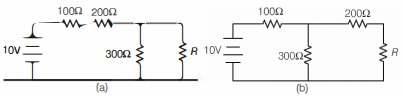
- 3A student was trying to construct the circuit shown in the figure below marked $(a)$, but ended up constructing the circuit marked $(b)$. Realising her mistake, she corrected the circuit, but to her surprise, the output voltage (across $R$ ) did not change. The value of resistance $R$ is ............ $\Omega$View Solution
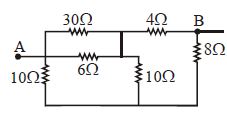
- 4The equivalent resistance across $AB$ would be ............ $\Omega$View Solution
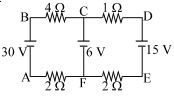
- 5View SolutionThe figure shows a network of four resistances and three batteries Which of the battery is getting charged.
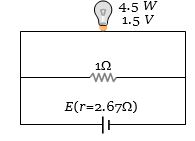
- 6A torch bulb rated as $4.5\, W$, $1.5\, V$ is connected as shown in the figure. The $e.m.f.$ of the cell needed to make the bulb glow at full intensity is ................ $V$View Solution
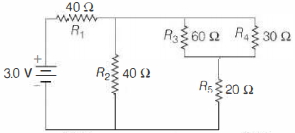
- 7In the circuit shown below, the resistances are given (in $\Omega$ ) and the battery is assumed ideal with emf equal to $3.0 \,V$. The resistor that dissipates the most power isView Solution
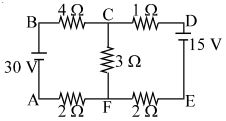
- 8The figure shows a network of five resistances and two batteries The total electrical power consumed by the circuit is ............... $W$View Solution
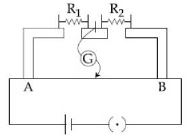
- 9In the experimental setup of meter bridge shown in the figure, the null point is obtained at a distance of $40\,cm$ from $A$. If a $10\,\Omega $ resistor is connected in series with $R_1$, the null point shifts by $10\,cm$. The resistance that should be connected in parallel with $\left( {{R_1} + 10} \right)\,\Omega $ such that the null point shifts back to its initial position is .............. $\Omega$View Solution
- 10An electric wire is connected across a cell of $e.m.f.$ The current $I$ is measured by an ammeter of resistance $R$. According to ohm's lawView Solution