Transverse wave propagates in a medium with a velocity of $1450\,m/s$ . The distance between the nearest points at which the oscillations of the particles carried in the opposite phase $\pi $ is $0.1\,m$ . What is the frequency of the wave ..... $Hz$ ?
Medium


Download our appand get started for free
Experience the future of education. Simply download our apps or reach out to us for more information. Let's shape the future of learning together!No signup needed.*
Similar Questions
- 1Two sound waves with wavelengths $5.0\,\, m$ and $5 .5\,\, m$ respectively, each propagate in a gas with velocity $330\,\, m/s.$ We expect the following number of beats per second.View Solution
- 2At $23^{\circ} C$, a pipe open at both ends resonates at a frequency of $450 \,Hz$. At what frequency does the same pipe resonate on a hot day when the speed of sound is $4 \%$ higher than it would be at $23^{\circ} C$ ?View Solution
- 3A tuning fork of unknown frequency produoes $4$ beats per second when sounded with another tuning fork of frequency $254 \,Hz$. It gives the same number of beats per second when unknown tuning fork loaded with wax. The unknown frequency before loading with wax is ..........View Solution
- 4A massless rod of length $L$ is suspended by two identical strings $AB$ and $CD$ of equal length. A block of mass $m$ is suspended from point $O$ such that $BO$ is equal to $‘x’$. Further it is observed that the frequency of $1^{st}$ harmonic in $AB$ is equal to $2^{nd}$ harmonic frequency in $CD$. $‘x’$ isView Solution
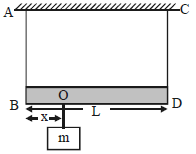
- 5The displacement of a particle is given by $y = 5 \times {10^{ - 4}}\sin (100t - 50x)$, where $x$ is in meter and $t$ in sec, find out the velocity of the wave .... $m/sec$View Solution
- 6View SolutionA pulse or a wave train travels along a stretched string and reaches the fixed end of the string. It will be reflected back with
- 7Spacing between two successive nodes in a standing wave on a string is $x$ . If frequency of the standing wave is kept unchanged but tension in the string is doubled, then new spacing between successive nodes will becomeView Solution
- 8View SolutionIf two waves of same frequency and same amplitude respectively, on superimposition produced a resultant disturbance of the same amplitude, the waves differ in phase by
- 9View SolutionThe sound carried by air from a sitar to a listener is a wave of the following type
- 10A sounding body of negligible dimension emitting a frequency of $150\,\, Hz$ is dropped from a height. During its fall under gravity it passes near a balloon moving up with a constant velocity of $2m/s$ one second after it started to fall.The difference in the frequency observed by the man in balloon just before and just after crossing the body will be : (Given that -velocity of sound $= 300m/s; g = 10m/s^2$)View Solution