Question
Try to collect all the currently accepted meanings for the word ‘species’. Discuss with your teacher the meaning of species in case of higher plants and animals on one hand, and bacteria on the other hand.

Answer

Species occupies a key position in classification. It is the lowest taxonomic category. It is a natural population of individuals or group of populations which resemble one another in all essential morphological and reproductive characters so that they are able to interbreed freely and produce fertile offsprings. Each species is also called genetically distinct and reproductively isolated natural population. May (1964) has defined species as “a group of actually or potentially interbreeding populations that are reproductively isolated from other such groups”. In higher plants and animals the term ‘species’ refers to a group of individuals that are able to interbreed freely and produce fertile offsprings. But, in case of bacteria interbreeding cannot serve as the best criteria for delimiting species because bacteria usually reproduce asexually. Conjugation, transformation and transduction, which are termed as sexual reproduction methods in bacteria, also do not correspond to true interbreeding. Thus, for bacteria many other characters such as molecular homology, biochemical, physiological, ecological and morphological characters are taken into consideration while classifying them.

Need a full question paper?

Generate a complete, print-ready paper with questions like this in minutes — across 16+ boards, with answer keys.

Start Generating Free

Similar questions

Mention the ploidy of the following: protonemal cell of a moss; primary endosperm nucleus in dicot, leaf cell of a moss; prothallus cell of a ferm; gemma cell in Marchantia; meristem cell of monocot, ovum of a liverwort, and zygote of a fern.
Can you identify the correct sequence of taxonomical categories?
  1. Species → Order → Phylum → Kingdom
  2. Genus → Species → Order → Kingdom
  3. Species → Genus → Order → Phylum
Cell membrane, also called plasma membrane, thin membrane that surrounds every living cell, delimiting the cell from the environment around it. Enclosed by this cell membrane are the cell’s constituents, large, water-soluble, highly charged molecules such as proteins, nucleic acids, carbohydrates, and substances involved in cellular metabolism. Cell membranes are composed primarily of fatty-acid based lipids and proteins. Membrane lipids are principally of two types, phospholipids and sterols (generally cholesterol). Both types share the defining characteristic of lipids—they dissolve readily in organic solvents—but in addition they both have a region that is attracted to and soluble in water.

(1).Plasma membrane is made up of
(a) A protein, a lipid and a cellulose layer
(b) Bimolecular lipid layer surrounded by protein layers
(c) A protein layer between two lipid layers
(d) A lipid layer between two protein layers

(2) Fluid mosaic model of cell was put forward by –
(a) Danielli and Dawson
(b) Singer and Nicolson
(c) Garner and Allard
(d) Watson and Crick

(3) Which of the following statements best describes the chemical composition of
plasma-membrane?
(a) Plasma membrane is composed of two layers—one layer of phospholipids and one layer
of proteins.
(b) Plasma membrane is composed of equal numbers of phospholipids, proteins, and
carbohydrates.
(c) Plasma membrane is bilayers of proteins with associated lipids and carbohydrates.
(d) Plasma membrane is bilayers of phospholipids with associated proteins and
carbohydrates.

(4) Most abundant lipid in the cell membrane is
(a) phospholipids (b) cerebrosides (c) glycolipids (d) None of these
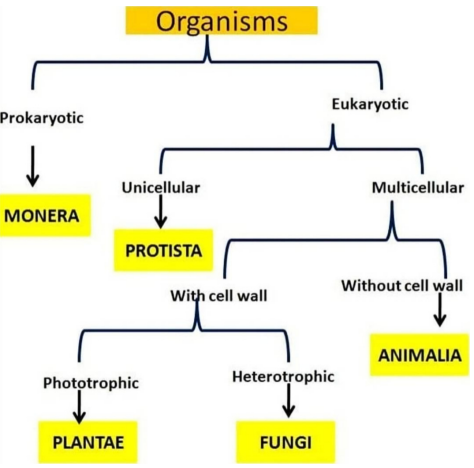
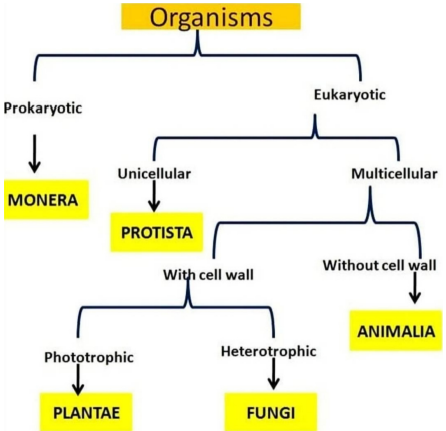
The process to standardize the naming of living organisms is called nomenclature. Obviously, the nomenclature is only possible when the organism is described correctly and we know to what organism the name is attached to this is identification. The system of providing scientific name with two components is called Binomial Nomenclature. The scientific name ensures that each organism is identified by only one name all across the world. They also ensures that such a name has not been used for any other known organism. Scientific names for plants are provided in ICBN and for animals, in ICZN.

(1). Who proposed binomial nomenclature?
(A) Carolus Linnaeus  (B) Charles Darwin  (C) Francis crick  (D) Albert Einstein

(2)Which of the following is an example of binomial scientific name?
(A) Green algae  (B) Rana tigrina  (C) Snow leopard  (D) China rose

(3). In binomial nomenclature, the name of organism consists of
(A) kingdom   (B) genus   (C) species   (D) Both B and C

(4). ICBN stands for
(A) Internal botanical congress names
(B) International center of botanical names
(C) International code of botanical nomenclature
(D) Internal code of botanical nomenclature

(5). In binomial nomenclature,------- epithet starts with small letter
(A) Genus
(B) Species
(C) Both A and B
(D) None of the above
Lipids form a heterogeneous group but all are made up of carbon hydrogen and oxygen. These are insoluble in water and soluble in organic solvents like acetone, ether, alcohol etc. The number of oxygen atoms is very small compared to carbon atoms. They need a large amount of oxygen for their oxidation to release energy. They could be simple lipids, compound lipids, and derived lipids. Simple lipids are esters of fatty acid and alcohol. Compound lipids are formed when simple lipids combine with another compounds for example glycolipids, phospholipids and lipoproteins. Derived lipids are of various types and important example being steroids.

(1) Lipids mainly consist of
(a) Carbon only
(b) carbon hydrogen and nitrogen
(c) carbon hydrogen and oxygen
(d) Hydrogen only

(2) Among the given options non-polymeric molecule is
(a) Nucleic acids (b) proteins (c) Lipids (d) polysaccharides

(3) An example of unsaturated fatty acid is
(a) oleic acid (b) stearic acid (c) Linoleic acid (d) both a and c

(4) The number of carbon atoms as compared to oxygen atoms in lipids is
(a) same (b) much less (c) much more (d) none of these.

(5) Steroids are an example of
(a) derived lipids (b) conjugated lipids (c) simple lipids (d) lipo proteins
Define the following :
(i) Vasa Recta (ii) Homeostasis (iii) Podocytes (iv) Juxtamedullary Nephron.
Alex used to go to vegetable market with his grandfather, a retired biology teacher. Grandfather told Alex that brinjal, chillies and tomato belong to the same family of plants and asked him to find out the similarity in these plants. Alex found that it's a large family, commonly called as the ' potato family'. Plants belonging to this family are mostly herbs, shrubs and rarely small trees. Many plants belonging to this family are source of food, spice, medicine, fumigatory, and ornamental.

(1).The name of this family is
(a) Solanaceae  (b) Fabaceae  (c) Liliaceae  (d) Brassica ear.

(2). Fruits of this family are known as
(a) Berry or capsule  (b) Legume  (c) Endosperm  (d) Cotyledon.

(3). Aestivation in calyx and corolla of this family is
(a) Valvate  (b) Imbricate  (c) Twisted  (d) Vexillary.

(4). Stamens of the flowers belonging to this family are mostly attached with petals.This condition is known as
(a) Epipetalous  (b) Epiphyllous  (c) Polyandrous  (d) Monoadelphous

(5). Medicinal plants belonging to this family are
(a) Belladonna, Ashwagandha
(b) Aloe, Asparagus
(c) Tobacco, Petunia
(d) Muliathi, Spice.