Two balls of masses ${m_1}$ and ${m_2}$ are separated from each other by a powder charge placed between them. The whole system is at rest on the ground. Suddenly the powder charge explodes and masses are pushed apart. The mass ${m_1}$ travels a distance ${s_1}$ and stops. If the coefficients of friction between the balls and ground are same, the mass ${m_2}$ stops after travelling the distance
Medium
Download our app for free and get started
(c) We know that in the given condition $s \propto \frac{1}{{{m^2}}}$
$\therefore \frac{{{s_2}}}{{{s_1}}} = {\left( {\frac{{m{_1}}}{{{m_2}}}} \right)^2}$ $⇒$ ${s_2} = {\left( {\frac{{m_1^{}}}{{m_2^{}}}} \right)^2} \times {s_1}$

Download our appand get started for free
Experience the future of education. Simply download our apps or reach out to us for more information. Let's shape the future of learning together!No signup needed.*
Similar Questions
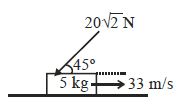
- 1A block of mass $5\, kg$ is kept on a rough horizontal floor. It is given a velocity $33\, m/s$ towards right. A force of $20\sqrt {2\,} \,N$ continuously acts on the block as shown in the figure. If the coefficient of friction between block and floor is $0.5$ the velocity of block after $3\, seconds$ is ........ $m/s$ ($g = 10\, m/s^2$)View Solution
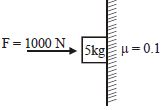
- 2For the given figure, if block remains in equilibrium position then find frictional force between block and wall ........ $N$View Solution
- 3$Assertion$ : Mountain roads rarely go straight up the slope.View Solution
$Reason$ : Slope of mountains are large, therefore more chances of vehicle to slip from roads - 4A block of mass $m$ is pressed against a vertical surface by a spring of unstretched length $l$ . If the coefficient of friction between the block and the surface is $\mu $. Choose the correct statement.View Solution
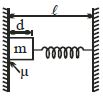
- 5A particle has initial velocity $10\,\, m/s$. It moves due to constant retarding force along the line of velocity which produces a retardation of $5\,\, m/s^2$. ThenView Solution
- 6A particle moves in a horizontal circle on the smooth inner surface of a hemispherical bowl of radius $R$. The plane of motion is at a depth $d$ below the centre of the hemisphere. The speed of the particle is :-View Solution
- 7Imagine $a$ situation in which the horizontal surface of block $M_0$ is smooth and its vertical surface is rough with $a$ coefficient of friction $\mu$ Consider a special situation in which both the faces of the block $M_0$ are smooth, as shown in adjoining figure. Mark out the correct statement $(s)$View Solution
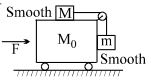
- 8A block starts moving up an inclined plane of inclination $30^{\circ}$ with an initial velocity of $v_{0}$. It comes back to its initial position with velocity $\frac{v_{0}}{2} .$ The value of the coefficient of kinetic friction between the block and the inclined plane is close to $\frac{ I }{1000},$ The nearest integer to $I$ is......View Solution
- 9A given object takes $n$ times the time to slide down $45^{\circ}$ rough inclined plane as it takes the time to slide down an identical perfectly smooth $45^{\circ}$ inclined plane. The coefficient of kinetic friction between the object and the surface of inclined plane is :View Solution
- 10A body takes time $t$ to reach the bottom of an inclined plane of angle $\theta$ with the horizontal. If the plane is made rough, time taken now is $2t$. The coefficient of friction of the rough surface isView Solution