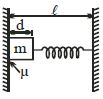
A block of mass $m$ is pressed against a vertical surface by a spring of unstretched length $l$ . If the coefficient of friction between the block and the surface is $\mu $. Choose the correct statement.
Medium


Download our appand get started for free
Experience the future of education. Simply download our apps or reach out to us for more information. Let's shape the future of learning together!No signup needed.*
Similar Questions
- 1A cyclist is travelling with velocity $v$ on a curved road of radius $R$. The angle $\theta$ through which the cyclist leans inwards is given byView Solution
- 2$A$ particle is moving in a circle :View Solution
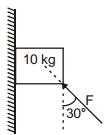
- 3A block of mass $10 \,kg$ is held at rest against a rough vertical wall $[\mu=0.5]$ under the action a force $F$ as shown in figure. The minimum value of $F$ required for it is ............ $N$ $\left(g=10 \,m / s ^2\right)$View Solution
- 4A block of mass $10\, kg$ moving at $10\,m/s$ is released to slide on rough surface having coefficient of friction $0.2.$ It will stop by travelling distance ........ $m$View Solution
- 5A force of $98\, N$ is required to just start moving a body of mass $100\, kg$ over ice. The coefficient of static friction isView Solution
- 6A block of mass $10\, kg$ moving at $10\,m/s$ is released to slide on rough surface having coefficient of friction $0.2.$ It will stop by travelling distance ........ $m$View Solution
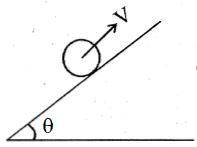
- 7View SolutionThe sphere is performing rolling up an inclined plane, the frictional force is
- 8A uniform rod of length $l$ is being rotated in a horizontal plane with a constant angular speed about an axis passing through one of its ends. If the tension generated in the rod due to rotation is $T(x)$ at a distance $x$ from the axis, then which of the following graphs depicts it most closely?View Solution
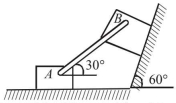
- 9In figure, two blocks are separated by a uniform strut attached to each block with frictionless pins. Block $A$ weighs $400\,N$, block $B$ weighs $300\,N$, and the strut $A B$ weigh $200\,N$. If $\mu=0.25$ under $B$, determine the minimum coefficient of friction under $A$ to prevent motion.View Solution
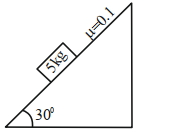
- 10A block of mass $5 \mathrm{~kg}$ is placed on a rough inclined surface as shown in the figure.If $\vec{F}_1$ is the force required to just move the block up the inclined plane and $\vec{F}_2$ is the force required to just prevent the block from sliding down, then the value of $\left|\vec{F}_1\right|-\left|\vec{F}_2\right|$ is : [Use $g=10 \mathrm{~m} / \mathrm{s}^2$ ]View Solution