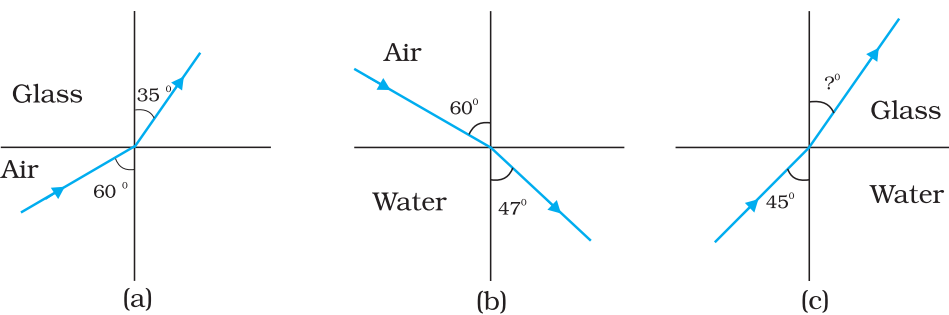
(a) and (b) show refraction of a ray in air incident at 60° with the normal to a glass-air and water-air interface, respectively. Predict the angle of refraction in glass when the angle of incidence in water is 45º with the normal to a water - glass interface.
Download our app for free and get started
As per the given figure, for the glass - air interface:
Angle of incidence, i = 60°
Angle of refraction, r= 35°
The relative refractive index of glass with respect to air is given by Snell's law as:
$=\text{Mh}_2=6\times4.7=28.2 \ \text{cm}$
$\mu^\circ_\text{g}=\frac{\sin\text{i}}{\sin\text{r}}$
$\frac{\sin 60^\circ}{\sin35^\circ}=\frac{0.8660}{0.5736}=1.51\dots(1)$
As per the given figure, for the air - water interface:
Angle of incidence, i = 60°
Angle of refraction, r= 47°
The relative refractive index of water with respect to air is given by Snell's law as:
$\mu^\circ_\text{g}=\frac{\sin\text{i}}{\sin\text{r}}$
$\frac{\sin 60^\circ}{\sin47^\circ}=\frac{0.8660}{0.5736}=1.184\dots(2)$
Using (1) and (2), the relative refractive index of glass with respect to water can be obtained as:
$\mu^\text{w}_\text{g}=\frac{\mu^\text{a}_\text{g}}{\mu^\text{a}_\text{w}}$
$=\frac{1.51}{1.184}=1.275$
The following figure shows the situation involving the glass - water interface.
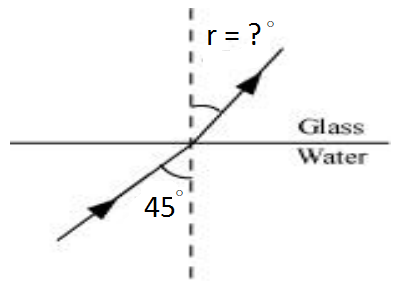
Angle of incidence, i= 45°
Angle of refraction = r
From Snell's law, rcan be calculated as:
$\frac{\sin\text{i}}{\sin\text{r}}=\mu^\text{w}_\text{g}$
$\frac{\sin45^\circ}{\sin\text{r}}=1.275$
$\sin\text{r}=\frac{\frac{1}{\sqrt2}}{1.275}=0.5546$
$\therefore \ \text{r}=\sin^{-1}(0.5546)=38.67^\circ$
Hence, the angle of refraction at the water - glass interface is 38.68°.
Angle of incidence, i = 60°
Angle of refraction, r= 35°
The relative refractive index of glass with respect to air is given by Snell's law as:
$=\text{Mh}_2=6\times4.7=28.2 \ \text{cm}$
$\mu^\circ_\text{g}=\frac{\sin\text{i}}{\sin\text{r}}$
$\frac{\sin 60^\circ}{\sin35^\circ}=\frac{0.8660}{0.5736}=1.51\dots(1)$
As per the given figure, for the air - water interface:
Angle of incidence, i = 60°
Angle of refraction, r= 47°
The relative refractive index of water with respect to air is given by Snell's law as:
$\mu^\circ_\text{g}=\frac{\sin\text{i}}{\sin\text{r}}$
$\frac{\sin 60^\circ}{\sin47^\circ}=\frac{0.8660}{0.5736}=1.184\dots(2)$
Using (1) and (2), the relative refractive index of glass with respect to water can be obtained as:
$\mu^\text{w}_\text{g}=\frac{\mu^\text{a}_\text{g}}{\mu^\text{a}_\text{w}}$
$=\frac{1.51}{1.184}=1.275$
The following figure shows the situation involving the glass - water interface.
Angle of incidence, i= 45°
Angle of refraction = r
From Snell's law, rcan be calculated as:
$\frac{\sin\text{i}}{\sin\text{r}}=\mu^\text{w}_\text{g}$
$\frac{\sin45^\circ}{\sin\text{r}}=1.275$
$\sin\text{r}=\frac{\frac{1}{\sqrt2}}{1.275}=0.5546$
$\therefore \ \text{r}=\sin^{-1}(0.5546)=38.67^\circ$
Hence, the angle of refraction at the water - glass interface is 38.68°.

Download our appand get started for free
Experience the future of education. Simply download our apps or reach out to us for more information. Let's shape the future of learning together!No signup needed.*
Similar Questions
- 1If light passes near a massive object, the gravitational interaction causes a bending of the ray. This can be thought of as happening due to a change in the effective refrative index of the medium given byView Solution
$\text{n}(\text{r})=1+2\frac{\text{GM}}{\text{rc}^2}$
where r is the distance of the point of consideration from the centre of the mass of the massive body, G is the universal gravitational constant, M the mass of the body and c the speed of light in vacuum. Considering a spherical object find the deviation of the ray from the original path as it grazes the object. - 2View SolutionDraw a ray diagram to show the formation of real image of the same size as that of the object placed in front of a converging lens. Using this ray diagram establish the relation between u, v and f for this lens.
- 3View Solution
- Draw a labelled ray diagram to obtain the real image formed by an astronomical telescope in normal adjustment position. Define its magnifying power.
- You are given three lenses of power 0.5 D, 4 D and 10 D to design a telescope:
- Which lenses should he used as objective and eyepiece? Justify your answer.
- Why is the aperture of the objective preferred to be large?
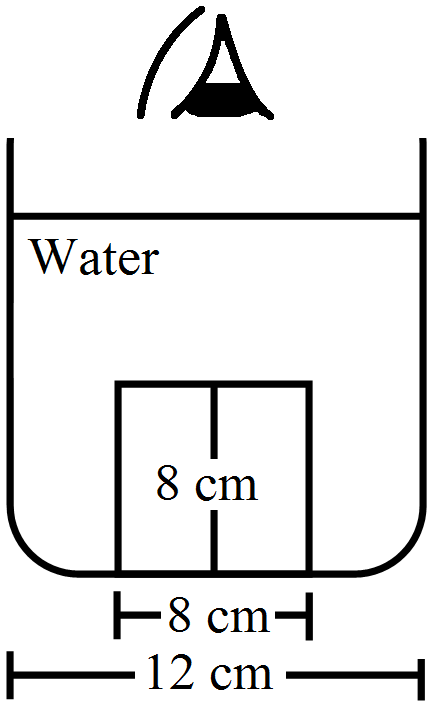
- 4A cylindrical vessel of diameter 12cm contains $800\pi\text{cm}^3$ of water. A cylindrical glass piece of diameter 8.0 cm and height 8.0cm is placed in the vessel. If the bottom of the vessel under the glass piece is seen by the paraxial rays, locate its image. The index of refraction of glass is 1.50 and that of water is 1.33.View Solution
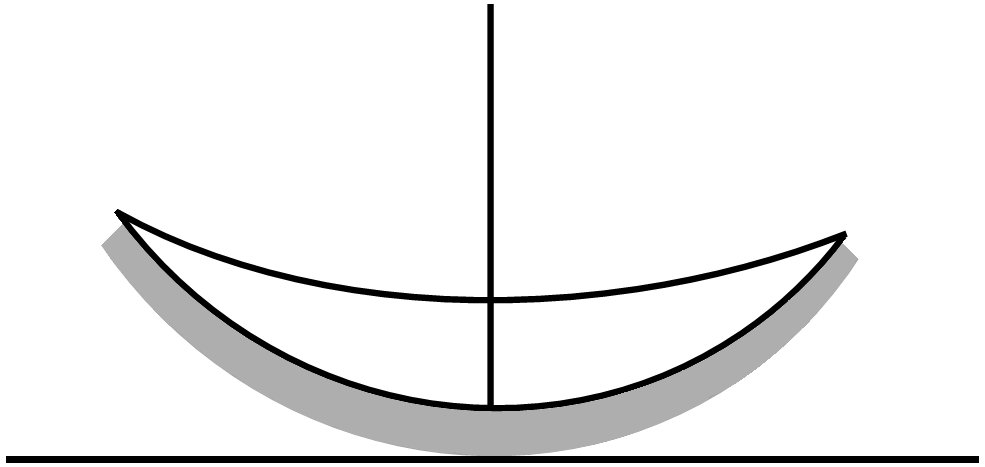
- 5The convex surface of a thin concavo-convex lens of glass of refractive index 1.5 has a radius of curvature 20cm. The concave surface has a radius of curvature 60cm. The convex side is silvered and placed on a horizontal surface as shown in figure.View Solution
- Where should a pin be placed on the axis so that its image is formed at the same place?
- If the concave part is filled with water $\Big(\mu=\frac{4}{3}\Big),$ find the distance through which the pin should be moved so that the image of the pin again coincides with the pin.
- 6View SolutionA diverging lens of focal length 20cm and a converging lens of focal length 30cm are placed 15cm apart with their principal axes coinciding. Where should an object be placed on the principal axis so that its image is formed at infinity?
- 7View Solution
- Draw a labelled ray diagram showing the formation of image by a compound microscope in normal adjustment. Derive the expression for its magnifying power.
- How does the resolving power of a microscope change when.
- The diameter of the objective lens is decreased,
- The wavelength of the incident light is increased.
- 8A small block of mass m and a concave mirror of radius R fitted with a stand lie on a smooth horizontal table with a separation d between them. The mirror together with its stand has a mass m. The block is pushed at t = 0 towards the mirror so that it starts moving towards the mirror at a constant speed V and collides with it. The collision is perfectly elastic. Find the velocity of the image:View Solution
- At a time $\text{t}<\frac{\text{d}}{\text{V}}$
- At a time $\text{t}>\frac{\text{d}}{\text{V}}.$
- 9View SolutionAn object 1.5 cm in size is placed on the side of the convex lens in the arrangement (a) above. The distance between the object and the convex lens is 40 cm. Determine the magnification produced by the two-lens system, and the size of the image.
- 10View SolutionA compound microscope consists of an objective of focal length 1cm and an eyepiece of focal length 5cm. An object is placed at a distance of 0.5cm from the objective. What should be the separation between the lenses so that the microscope projects an inverted real image of the object on a screen 30cm behind the eyepiece?