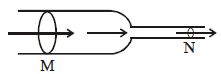
Two capillaries of same length and radii in the ratio $1 : 2$ are connected in series. A liquid flows through them in streamlined condition. If the pressure across the two extreme ends of the combination is $ 1 m$ of water, the pressure difference across first capillary is...... $m$
Diffcult


Download our appand get started for free
Experience the future of education. Simply download our apps or reach out to us for more information. Let's shape the future of learning together!No signup needed.*
Similar Questions
- 1A horizontal pipe line carries water in a streamline flow.At a point along the tube where the cross-sectional area is $10^{-2}$ $m^2$, the water velocity is $2$ $ms^{^{-1}}$ and the pressure is $8000 $ $Pa$. The pressure of water at another point where the cross-sectional area is $0.5$ $\times 10^{-2}$ $m^2$ is ........ $Pa$View Solution
- 2A train with cross-sectional area $S _{ t }$ is moving with speed $v_t$ inside a long tunnel of cross-sectional area $S _0\left( S _0=4 S _{ t }\right)$. Assume that almost all the air (density $\rho$ ) in front of the train flows back between its sides and the walls of the tunnel. Also, the air flow with respect to the train is steady and laminar. Take the ambient pressure and that inside the train to be $p _0$. If the pressure in the region between the sides of the train and the tunnel walls is $p$, then $p _0- p =\frac{7}{2 N } \rho v_{ t }^2$. The value of $N$ is. . . . .View Solution
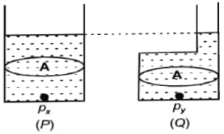
- 3Figure shows two containers $P$ and $Q$ with same base area $A$ and each filled upto same height with same liquid. Select the correct alternative .............View Solution
- 4A cubical block of side $'a'$ and density $'\rho '$ slides over a fixed inclined plane with constant velocity $'v'$ . There is a thin film of viscous fluid of thickness $'t'$ between the plane and the block. Then the coefficient of viscosity of the thin film will beView Solution

- 5A small spherical ball of radius $r$, falling through a viscous medium of negligible density has terminal velocity ' $v$ '. Another ball of the same mass but of radius $2 r$, falling through the same viscous medium will have terminal velocity:View Solution
- 6A block of volume $V$ and of density $\sigma _b$ is placed in liquid of density $\sigma _l(\sigma _l > \sigma _b)$ , then block is moved upward upto a height $h$ and it is still in liquid. The increase in gravitational potential energy of the system isView Solution
- 7A stone is projected vertically up from the bottom of a water tank. Assuming no water resistance it will go up and come down in same time but if water drag is present then the time it takes to go up, $t_{up}$ and the time it takes to come down, $t_{down}$ are related asView Solution
- 8Force in Column - $\mathrm{I}$ and its use is in Column - $\mathrm{II}$ are given. Match them appropriately.View Solution
Column - $\mathrm{I}$ Column - $\mathrm{II}$ $(a)$ Cohesive force $(i)$ Useful for writing by chalk on blackboard. $(b)$ Adhesive force $(ii)$ Useful in soldering. $(iii)$Useful for formation of spherical drops of liquid. - 9The velocity of a small ball of mass ' $m$ ' and density $d _{1}$, when dropped in a container filled with glycerine, becomes constant after some time. If the density of glycerine is $d _{2}$, then the viscous force acting on the ball, will beView Solution
- 10Horizontal tube of non-uniform cross-section has radii of $0.1\,m$ and $0.05\,m$ respectively at $M$ and $N.$ For a stream-line flow of liquid the rate of liquid flow isView Solution