MCQ
Two coherent light source $A$ and $B$ are at a distance $3\, \lambda$ from each other $(\lambda =$ wavelength). The distances from $A$ on the $x$ -axis at which the  interference is constructive are 
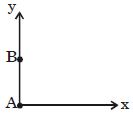
  • A
    $3 \lambda$
  • $4 \lambda$
  • C
    $\lambda / 4$
  • D
    $8.75 \lambda$

Answer

Correct option: B.
$4 \lambda$
b

Need a full question paper?

Generate a complete, print-ready paper with questions like this in minutes — across 16+ boards, with answer keys.

Start Generating Free

Similar questions

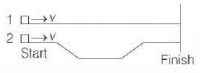
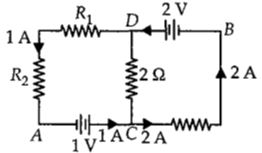
Two small blocks slide without losing contact with the surface along two frictionless tracks $1$ and $2$ , starting at the same time with same initial speed $v$. Track $1$ is perfectly horizontal, while track $2$ has a dip in the middle, as shown in the figure.Which block reaches the finish line first?[Hint: Use velocity-time graph to solve]
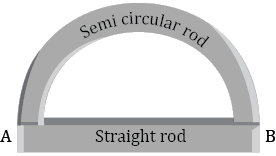
Two rods (one semi-circular and other straight) of same material and of same cross-sectional area are joined as shown in the figure. The points $A$ and $B$ are maintained at different temperature. The ratio of the heat transferred through a cross-section of a semi-circular rod to the heat transferred through a cross section of the straight rod in a given time is
$A$ concave mirror is placed on a horizontal table, with its axis directed vertically upwards. Let $O$ be the pole of the mirror and $C$ its centre of curvature. $A$ point object is placed at $C$. It has a real image, also located at $C$ (a condition called auto-collimation). If the mirror is now filled with water, the image will be:
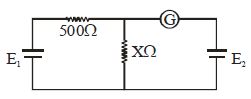
In the adjoining circuit, the battery $E_1$ has an emf of $12\, volt$ and zero internal resistance while the battery $E_2$ has an $emf$ of $2\, volt$. If the galvanometer $G$ reads zero, then the value of the resistance $X$ (in $ohm$ ) is
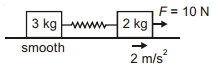
What is the acceleration of $3 \,kg$ mass when acceleration of $2 \,kg$ mass is $2 \,m / s ^2$ as shown is ............... $m / s ^2$
In the circuit shown in the figure, if the potential at point $A$ is taken to be zero, the potential at point $B$ is ................ $V$
A convex lens of crown glass ($n =1.525$) will behave as a divergent lens if immersed in
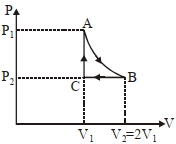
$n$ mole a perfect gas undergoes a cyclic process $ABCA$ (see figure) consisting of the following processes.

$A \rightarrow B :$ Isothermal expansion at temperature $T$ so that the volume is doubled from $V _{1}$ to $V _{2}=2 V _{1}$ and pressure changes from $P _{1}$ to $P _{2}$

$B \rightarrow C :$ Isobaric compression at pressure $P _{2}$ to initial volume $V _{1}$

$C \rightarrow A$ : Isochoric change leading to change of pressure from $P _{2}$ to $P _{1}$

Total workdone in the complete cycle $ABCA$ is

A denser medium of refractive index $1.5$ has a concave surface of radius of curvature $12\,cm$. An object is situated in the denser medium at a distance of $9 \,cm$ from the pole. Locate the image due to refraction in air.
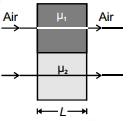
Two light rays initially in same phase travel through two media of equal length $L$ having refractive index $m _1$ and $m_2\left(m_1 > m_2\right)$ as shown in figure. If the wave length of light rays in air is $1$ , the phase difference of the emerging rays is given by