MCQ
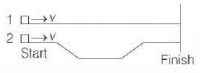
Two small blocks slide without losing contact with the surface along two frictionless tracks $1$ and $2$ , starting at the same time with same initial speed $v$. Track $1$ is perfectly horizontal, while track $2$ has a dip in the middle, as shown in the figure.Which block reaches the finish line first?[Hint: Use velocity-time graph to solve]
  • A
    Block on track $1$ reaches the finish line first
  • Block on track $2$ reaches the finish line first
  • C
    Both blocks reach the finish line at the same time
  • D
    It depends on the length of the dip in the second track. relative to the total length of the tracks
Answer

Correct option: B.
Block on track $2$ reaches the finish line first
b
(b)

Block $2$ moves for a certain period of time with higher velocity (compared to that of block $1$).

So, block $2$ finishes the race earlier.

Need a full question paper?

Generate a complete, print-ready paper with questions like this in minutes — across 16+ boards, with answer keys.

Start Generating Free

Similar questions

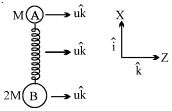
Two masses $A$ and $B$ of mass $M$ and $2M$ respectively are connected by a compressed ideal spring. The system is placed on $a$ horizontal frictionless table and given $a$ velocity $u\, \hat k$ in the $z$ -direction as shown in the figure. The spring is then released. In the subsequent motion the line from $B$ to $A$ always points along the $\hat i$ unit vector. At some instant of $\rho$ time mass $B$ has $a$ $x$ -component of velocity as $V_x\, \hat i$ . The velocity ${\vec V_A}$ of as $A$ at that instant is
The activity of a sample is $64 × 10^{-5}\, Ci.$ Its half-life is $3\, days$. The activity will become $5 × 10^{-6}\, Ci$ after .........$days$
Hydrogen $(_1H^1),$ Deuterium $(_1H^2)$,singly ionised Helium $(_2He^4)^+$ and doubly ionised lithium ${\left( {{}_3^6Li} \right)^{ + + }}$, all have one electron around the nucleus. Consider an electron transition from $n = 2$ to $n = 1$. If the wavelengths of emitted radiation are $λ_1,λ_2,λ_3$ and $λ_4$ respectively then approximately which one of the following is correct?
The threshold frequency of a metal with work function $6.63\  \mathrm{eV}$ is:
A particle is projected from the ground at an angle of $\theta $ with the horizontal with an initial speed of $u$. Time after which velocity vector of the projectile is perpendicular to the initial velocity is
A proton moving with a constant velocity passes through a region of space without any change in its velocity. If $\vec{E}$ and $\vec{B}$ represent the electric and magnetic fields respectively, then the region of space may have.
(A)E 0,B 0
(B)E 0,B 0
(C)$E \neq 0, B=0$
(D)$E \neq 0, B \neq 0$
Choose the most appropriate answer from the options given below :
When water is heated from $0$ to $4\,^oC$
Column $I$ gives some devices and Column $II$ gives some process on which the functioning of these devices depend. Match the devices in Column $I$ with the processes in Column $II$ and indicate your answer by darkening appropriate bubbles in the $4 \times 4$ matrix given in the $ORS$.
Column $I$ Column $II$
$(A)$ Bimetallic strip $(p)$ Radiation from a hot body
$(B)$ Steam engine $(q)$ Energy conversion
$(C)$ Incandescent lamp $(r)$ Melting
$(D)$ Electric fuse $(s)$ Thermal expansion of solids
Wavelength of a $1 \;keV$ photon is $1.24 \times {10^{ - 9}}\;m$. What is the frequency of $1 \;MeV$ photon
Two particle executing $S.H.M.$ of same amplitude of $20 \,cm$ with same period along the same line about same equilibrium position. The maximum distance between the two is $20 \,cm$. Their phase difference in radian is equal to