Question
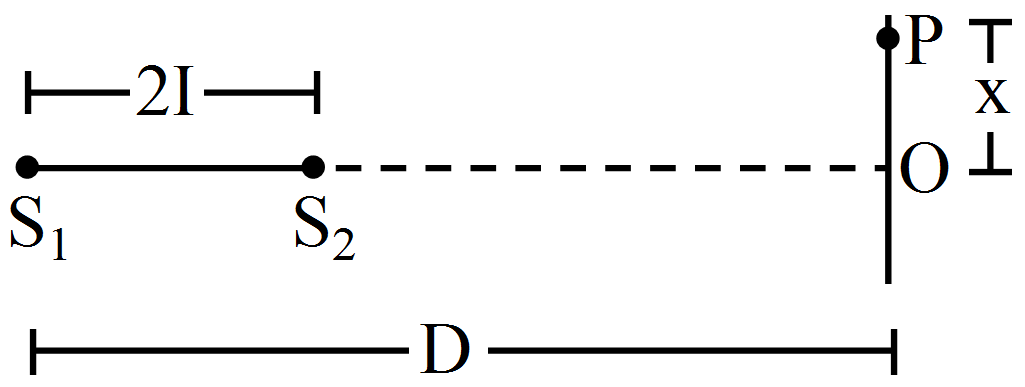
Two coherent narrow slits emitting sound of wavelength $\lambda$ in the same phase are placed parallel to each other at a small separation of $2\lambda.$ The sound is detected by moving a detector on the screen $\sum$ at a distance $\text{D}(>>\lambda)$ from the slit $S_1$ as shown in figure. Find the distance x such that the intensity at P is equal to the intensity at 0.
Answer

Given: $S_1\ \&\ S_2$ are in the same phase. At O, there will be maximum intensity. There will be maximum intensity at P. From the(in questions):$\triangle\text{S}_1\text{PO}$ and $\triangle\text{S}_2\text{PO}$ are right-angled triangle
So, $(\text{S}_1\text{P})^2-(\text{S}_2\text{P})^2$$=\big[\text{D}^2+\text{x}^2\big]-\Big[(\text{D}-2\lambda)^2+\text{x}^2\Big]^2$
$=4\lambda\text{D}+4\lambda^2=4\lambda\text{D}$
$\Big(\lambda^2$ is small and can be neglected$\Big)$
$\Rightarrow(\text{S}_1\text{P}+\text{S}_2\text{P})(\text{S}_1\text{P}-\text{S}_2\text{P})=4\lambda\text{D}$
$\Rightarrow(\text{S}_1\text{P}-\text{S}_2\text{P})=\frac{4\lambda\text{D}}{(\text{S}_1\text{P}+\text{S}_2\text{P})}$
$\Rightarrow\text{S}_1\text{P}-\text{S}_2\text{P}=\frac{4\lambda\text{D}}{2\sqrt{\text{x}^2+\text{D}^2}}$
For constructive interference, path difference $=\text{n}^\lambda$ So, $\text{S}_1\text{P}-\text{S}_2\text{P}=\frac{4\lambda\text{D}}{2\sqrt{\text{x}^2+\text{D}^2}}=\text{n}\lambda$$\Rightarrow\frac{2\text{D}}{\sqrt{\text{x}^2+\text{D}^2}}=\text{n}$
$\Rightarrow\text{n}^2\big(\text{x}^2+\text{D}^2\big)=4\text{D}^2$
$\Rightarrow\text{n}^2\text{x}^2+\text{n}^2\text{D}^2=4\text{D}^2$
$\Rightarrow\text{n}^2\text{x}^2=4\text{D}^2-\text{n}^2\text{D}^2$
$\Rightarrow\text{n}^2\text{x}^2=\text{D}^2(4-\text{n}^2)$
$\Rightarrow\text{x}=\frac{\text{D}}{\text{n}}\sqrt{4-\text{n}^2}$
When n = 1,$\text{x}=\sqrt{3}\text{D}$ $(1^{st}$ order$).$
When n = 2,$\text{x}=0$ $(2^{nd}$ order$).$
So when $\text{x}=\sqrt{3}\text{D},$ the intensity at P is equal to the intensity at O.

Need a full question paper?

Generate a complete, print-ready paper with questions like this in minutes — across 16+ boards, with answer keys.

Start Generating Free

Similar questions

Explain emf, potential difference and internal resistance of cell and derive the relation between them. (or derive the relation between emf, potential difference and internal resistance of the cell.)
A tightly-wound, long solenoid carries a current of 2.00A. An electron is found to execute a uniform circular motion inside the solenoid with a frequency of $1.00 \times 10^8$ rev/s. Find the number of turns per metre in the solenoid.
Answer the following question:
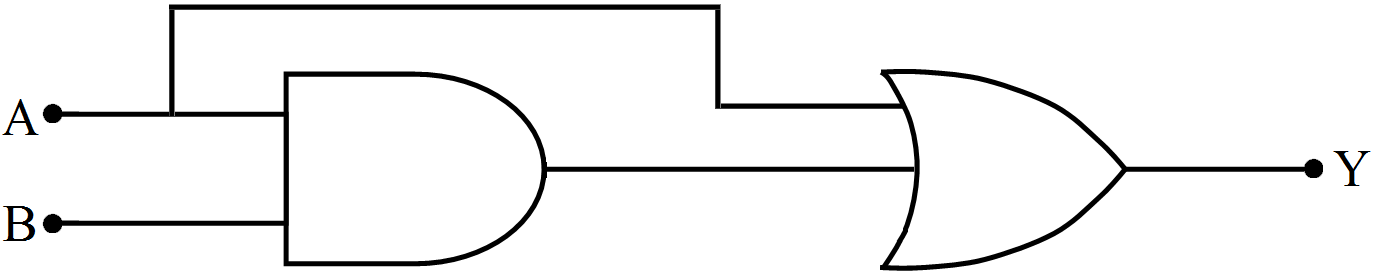
  1. Write the truth table of the following gate.
  1. What will be the values of inputs A and B for the Boolean expression.
$\text{A}\bar{+}\text{B}).(\text{A}\bar{.}\text{B})=1$
What do you understand by controlled and uncontrolled chain reactions?
A simple microscope has a magnifying power of 3.0 when the image is formed at the near point (25cm) of a normal eye.
  1. What is its focal length?
  2. What will be its magnifying power if the image is formed at infinity?
In a silicon transistor, the base current is changed by $20\mu\text{A}.$ This results in a change of 0.02V in base to emitter voltage and a change of 2mA in the collector current.
  1. Find the input resistance, $\beta-$ac and trans conductance of the transistor.
  2. This transistor is used as an amplifier in CE configuration with a load resistance $5\text{k}\Omega$ What is the voltage gain of the amplifier?
A certain sample of a radioactive material decays at the rate of 500 per second at a certain time. The count rate falls to 200 per second after 50 minutes.
  1. What is the decay constant of the sample?
  2. What is its half-life?
How many time constants will elapse before the current in a charging RC circuit drops to half of its initial value? Answer the same question for a discharging RC circuit.
A rectangular wire loop of width a is suspended from the insulated pan of a spring balance, as shown in A current i exists in the anti-clockwise direction in the loop. A magnetic field Bexists in the lower region. Find the change in the tension of the spring if the current in the loop is reversed.
A monochromatic light source of intensity 6mW emits $8 \times 10^{16}$ photons per second. This light ejects photoelectrons from a metal surface. The stopping potential for this setup is 2.0V. Calculate the work function of the metal.