Two conducting spheres of radii $5\, cm$ and $10\, cm$ are given a charge of $15\,\mu C$ each. After the two spheres are joined by a conducting wire, the charge on the smaller sphere is.......$\mu C$
Medium
Download our app for free and get started
(b) Charge on smaller sphere
= Total charge $\left( {\frac{{{r_1}}}{{{r_1} + {r_2}}}} \right) = 30\,\left( {\frac{5}{{5 + 10}}} \right) = 10\,\mu C$
= Total charge $\left( {\frac{{{r_1}}}{{{r_1} + {r_2}}}} \right) = 30\,\left( {\frac{5}{{5 + 10}}} \right) = 10\,\mu C$

Download our appand get started for free
Experience the future of education. Simply download our apps or reach out to us for more information. Let's shape the future of learning together!No signup needed.*
Similar Questions
- 1In a certain region of space, variation of potential with distance from origin as we move along $x$-axis is given by $V=8 x^2+2$, where $x$ is the $x$-coordinate of a point in space. The magnitude of electric field at a point $(-4,0)$ is .......... $V / m$View Solution
- 2Two identical positive charges are placed on the $y$-axis at $y=-a$ and $y=+a$. The variation of $V$ (electric potential) along $x$-axis is shown by graphView Solution
- 3There are two identical capacitors, the first one is uncharged and filled with a dielectric of constant $K$ while the other one is charged to potential $V$ having air between its plates. If two capacitors are joined end to end, the common potential will beView Solution
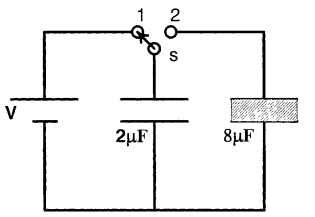
- 4A $2 \ \mu F$ capacitor is charged as shown in figure. The percentage of its stored energy dissipated after the switch $S$ is turned to position $2$ isView Solution
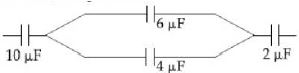
- 5In the figure shown below, the charge on the left plate of the $10\, \mu F$ capacitor is $-30\,\mu C.$ The charge on the right place of the $6\,\mu F$ capacitor is.....$\mu C$View Solution
- 6A particle of mass $‘m’$ and charge $‘q’$ is accelerated through a potential difference of $V$ volt, its energy will beView Solution
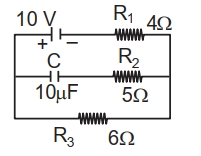
- 7In an electrical circuit drawn below the amount of charge stored in the capacitor is___ $\mu \mathrm{C}$.View Solution
- 8Two charged particles of masses $m$ and $2m$ have charges $+2q$ and $+q$ respectively. They are kept in uniform electric field and allowed to move for some time. The ratio of their kinetic energies will beView Solution
- 9A proton is accelerated through $50,000\, V$. Its energy will increase byView Solution
- 10Charge $q_{2}$ is at the centre of a circular path with radius $r$. Work done in carrying charge $q_{1}$, once around this equipotential path, would beView Solution