Two identical positive charges are placed on the $y$-axis at $y=-a$ and $y=+a$. The variation of $V$ (electric potential) along $x$-axis is shown by graph
Medium
Download our app for free and get started
(a)
$V=\frac{2 k q}{\sqrt{a^2+x^2}}$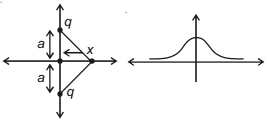

Download our appand get started for free
Experience the future of education. Simply download our apps or reach out to us for more information. Let's shape the future of learning together!No signup needed.*
Similar Questions
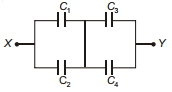
- 1In the circuit shown below $C_1=10 \,\mu F , C_2=C_3=20 \,\mu F$, and $C_4=40 \,\mu F$. If the charge on $C_1$ is $20 \,\mu C$ then potential difference between $X$ and $Y$ is ......... $V$View Solution
- 2The electric potential at the surface of an atomic nucleus $(Z = 50)$ of radius $9.0×{10^{ - 13}}\, cm$ isView Solution
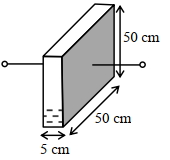
- 3A container has a base of $50 \mathrm{~cm} \times 5 \mathrm{~cm}$ and height $50 \mathrm{~cm}$, as shown in the figure. It has two parallel electrically conducting walls each of area $50 \mathrm{~cm} \times 50 \mathrm{~cm}$. The remaining walls of the container are thin and non-conducting. The container is being filled with a liquid of dielectric constant $3$ at a uniform rate of $250 \mathrm{~cm}^3 \mathrm{~s}^{-1}$. What is the value of the capacitance of the container after $10$ seconds? [Given: Permittivity of free space $\in_0=9 \times 10^{-12} \mathrm{C}^2 \mathrm{~N}^{-1} \mathrm{~m}^{-2}$, the effects of the non-conducting walls on the capacitance are negligible]View Solution
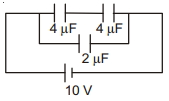
- 4If initial charge on all the capacitors were zero, work done by the battery in the circuit shown is ........... $mJ$View Solution
- 5A $6\,\mu F$ capacitor is charged from $10\;volts$ to $20\;volts$. Increase in energy will beView Solution
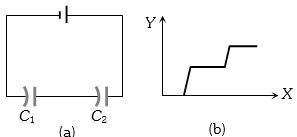
- 6Figure $(A)$ shows two capacitors connected in series and joined to a battery. The graph in figure $(B)$ shows the variation in potential as one moves from left to right on the branch containing the capacitors, ifView Solution
- 7If $3$ charges are placed at the vertices of equilateral triangle of charge ‘$q$’ each. What is the net potential energy, if the side of equilateral triangle is $l\, cm$View Solution
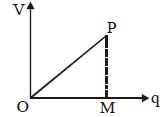
- 8Charge $'q'$ on a capacitor varies with voltage $'V'$ as shown. The area of $\Delta OPM$ representsView Solution
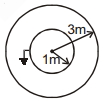
- 9Figure shows a solid conducting sphere of radius $1 m$, enclosed by a metallic shell of radius $3 \,m$ such that their centres coincide. If outer shell is given a charge of $6 \,\mu C$ and inner sphere is earthed, find magnitude charge on the surface of inner shell is ............. $\mu C$View Solution
- 10An initially uncharged capacitor $C$ is being charged by a battery of emf $E$ through a resistance $R$ upto the instant, when the capacitor is charged to the potential $E / 2$, then the ratio of the work done by the battery to the heat dissipated by the resistor is given byView Solution