Two electric bulbs whose resistances are in the ratio of $1 : 2$ are connected in parallel to a constant voltage source. The powers dissipated in them have the ratio
Easy


Download our appand get started for free
Experience the future of education. Simply download our apps or reach out to us for more information. Let's shape the future of learning together!No signup needed.*
Similar Questions
- 1$n$ identical bulbs, each designed to draw a power $p$ from a certain voltage supply, are joined in series across that supply. The total power which they will draw isView Solution
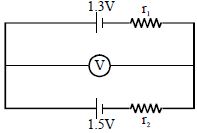
- 2In given diagram ideal voltmeter $V$ reads $1.45\,V$ then relation between $r_1$ and $r_2$ isView Solution
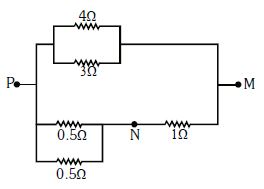
- 3In the circuit shown, the current through the $4\,\Omega $ resistor is $1\, amp$ when the points $P$ and $M$ are connected to a d.c. voltage source. The potential difference between the points $M$ and $N$ is ............... $volt$View Solution
- 4When two identical batteries of internal resistance $1 \Omega$ each are connected in series across a resistor $\mathrm{R}$, the rate of heat produced in $R$ is $J_1$. When the same batteries are connected in parallel across $R$, the rate is $\mathrm{J}_2$. If $\mathrm{J}_1=2.25 \mathrm{~J}_2$ then the value of $\mathrm{R}$ in $\Omega$ isView Solution
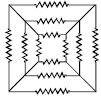
- 5Twelve resistors each of resistance $16 \,\Omega $ are connected in the circuit as shown. The net resistance between $AB$ (any two conjugate points of outer square) is ............... $\Omega$View Solution
- 6View SolutionAssertion : The electric bulbs glows immediately when switch is on.
Reason : The drift velocity of electrons in a metallic wire is very high.
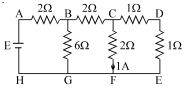
- 7The figure shows a network of resistors and $a$ battery. If $1\,A$ current flowsthrough the branch $CF$, then answer the following questions The $\mathrm{emf}$ $E$ of the battery is If a zero resistance wire is connected in parallel to branch $CF$ ............... $V$View Solution
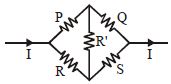
- 8Wheat stone bridge is balanced. Find ratio of electric power dissipated in $(P + Q)$ to $(R + S)$View Solution
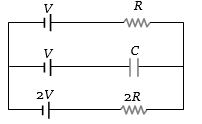
- 9View SolutionIn the given circuit, with steady current, the potential drop across the capacitor must be
- 10View SolutionWhat is immaterial for an electric fuse wire