Two heaters $A$ and $B$ have power rating of $1 \mathrm{~kW}$ and $2 \mathrm{~kW}$, respectively. Those two are first connected in series and then in parallel to a fixed power source. The ratio of power outputs for these two cases is:
NEET 2024, Medium
Download our app for free and get started
Power Consumed $=P=\frac{V^2}{R}$
$\frac{P_A}{P_B}=\frac{R_B}{R_A}$
$R_A=2 R_B$
For Series Combination
$P_S=\frac{V^2}{3 R_B}$
For Parallel Combination
$P_P=\frac{3 V^2}{2 R_B}$
$\frac{P_S}{P_P}=\frac{2}{9}$

Download our appand get started for free
Experience the future of education. Simply download our apps or reach out to us for more information. Let's shape the future of learning together!No signup needed.*
Similar Questions
- 1Two cells of $e.m.f.$ $E_1$ and $E_2$ are joined in series and the balancing length of the potentiometer wire is $625$ $cm$. If the terminals of $E_1$ are reversed, the balancing length obtained is $125 \,cm$. Given $E_2 > E_1$, the ratio $E_1: E_2$ will beView Solution
- 2The $H$ amount of thermal energy is developed by a resistor in $10\,s$ when a current of $4\,A$ is passed through it. If the current is increased to $16\,A$, the thermal energy developed by the resistor in $10\,s$ will be $........\,H$View Solution
- 3A cell of internal resistance $r$ is connected across an external resistance $n r$. Then the ratio of the terminal voltage to the emf of the cell isView Solution
- 4In a potentiometer circuit a cell of $EMF$ $1.5\, {V}$ gives balance point at $36\, {cm}$ length of wire. If another cell of $EMF$ $2.5\, {V}$ replaces the first cell, then at what length of the wire, the balance point occurs ? (in $cm$)View Solution
- 5Two bulbs consume same power when operated at $200\, V$ and $300\, V$ respectively. When these bulbs are connected in series across a $D.C$. source of $500\, V$, thenView Solution
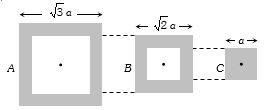
- 6Following figure shows cross-sections through three long conductors of the same length and material, with square cross-section of edge lengths as shown. Conductor $B$ will fit snugly within conductor $A$, and conductor $C$ will fit snugly within conductor $B$. Relationship between their end to end resistance isView Solution
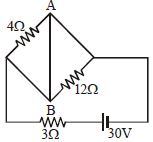
- 7View SolutionConsidering the following circuit, select the correct alternative
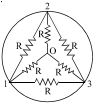
- 8Inside $a$ super conducting ring six identical resistors each of resistance $R$ are connected as shown in figure. Imagine a battery of $emf$ $E$ between the point $0$ and $1$, with its positive terminal connected with $O.$View Solution
- 9View SolutionA constant voltage is applied between two ends of a metallic wire. If the length is halved and the radius of the wire is doubled, the rate of heat developed in the wire will be
- 10View SolutionKirchhoff's second law is based on the law of conservation of