MCQ
silver atom in a solid oscillates in simple harmonic motion in some direction with a frequency of $10^{12}  /sec$. What is the force constant of the bonds connecting one atom with the other? ................ $\mathrm{N/m}$     (Mole wt. of silver $= 108 $ andAvagadro number $= 6.02 \times 10^{23}$ $gm \ mole^{ -1}$ )
  • $7.1$ 
  • B
    $2.2 $ 
  • C
    $5.5 $ 
  • D
    $6.4 $ 

Answer

Correct option: A.
$7.1$ 
a
As we know, frequency in $SHM$

$\mathrm{f}=\frac{1}{2 \pi} \sqrt{\frac{\mathrm{k}}{\mathrm{m}}}=10^{12}$ where $\mathrm{m}=\mathrm{mass}$ of one atom

Mass of one atom of silver, $=\frac{108}{\left(6.02 \times 10^{23}\right)} \times 10^{-3} \mathrm{kg}$

$\frac{1}{2 \pi} \sqrt{\frac{\mathrm{k}}{108 \times 10^{-3}} \times 6.02 \times 10^{23}}=10^{12}$

Solving we get, spring constant, $\mathrm{K}=7.1 \mathrm{N} / \mathrm{m}$

Need a full question paper?

Generate a complete, print-ready paper with questions like this in minutes — across 16+ boards, with answer keys.

Start Generating Free

Similar questions

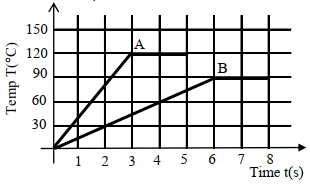
Two different metal bodies $A$ and $B$ of equal mass are heated at a uniform rate under similar conditions. The variation of temperature of the bodies is graphically represented as shown in the figure. The ratio of specific heat capacities is :
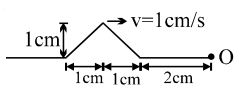
A wave pulse on a string has the dimension shown in figure. The waves speed is $v = 1 \,\,cm/s$. If point $O$ is a free end. The shape of wave at time $t = 3 \,\,s$ is :
The Doppler's effect is applicable for
A uniform meter scale balances at the $40\,cm$ mark when weights of $10\,g$ and $20\,g$ are suspended from the $10\,cm$ and $20\,cm$ marks. The weight of the metre scale is ...... $g$
The work done in joules in increasing the extension of a spring of stiffness $10\, N/cm$ from $4\, cm$ to $6\, cm$ is:
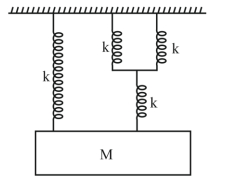
The time period of simple harmonic motion of mass $\mathrm{M}$ in the given figure is $\pi \sqrt{\frac{\alpha M}{5 K}}$, where the value of $\alpha$ is____.
A car is moving with velocity $V$. If stop after applying break at a distance of $20\; m$. If velocity of car is doubled, then how much distance it will cover (travel) after applying break
In the List-$I$ below, four different paths of a particle are given as functions of time. In these functions, $\alpha$ and $\beta$ are positive constants of appropriate dimensions and $\alpha \neq \beta$. In each case, the force acting on the particle is either zero or conservative. In List-II, five physical quantities of the particle are mentioned: $\overrightarrow{ p }$ is the linear momentum, $\bar{L}$ is the angular momentum about the origin, $K$ is the kinetic energy, $U$ is the potential energy and $E$ is the total energy. Match each path in List-$I$ with those quantities in List-$II$, which are conserved for that path.
List-$I$ List-$II$
$P$ $\dot{r}(t)=\alpha t \hat{t}+\beta t \hat{j}$ $1$ $\overrightarrow{ p }$
$Q$ $\dot{r}(t)=\alpha \cos \omega t \hat{i}+\beta \sin \omega t \hat{j}$ $2$ $\overrightarrow{ L }$
$R$ $\dot{r}(t)=\alpha(\cos \omega t \hat{i}+\sin \omega t \hat{j})$ $3$ $K$
$S$ $\dot{r}(t)=\alpha t \hat{i}+\frac{\beta}{2} t^2 \hat{j}$ $4$ $U$
  $5$ $E$
When 1 m, 1 kg and 1 min are taken as the fundamental units, the magnitude of the force is 36 units. What will be the value of this force in CGS system?
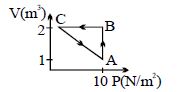
An ideal gas is taken through the cycle $A \to B \to C \to A$ , as shown in the figure. If the net heat supplied to the gas in the cycle is $5\ J$, the work done by the gas in the process $C \to A$ is  .... $J$