Question
Two identical blocks are kept on a frictionless horizontal table connected by a spring of stiffness K and of original length $\ell_0$ A total charge Q is distributed on the block such that maximum elongation of sparing at equilibrium is equal to x value of q is:
Answer

  1. $2(\ell_0+\text{x})\sqrt{4\pi\epsilon_0\text{kx}}$

Need a full question paper?

Generate a complete, print-ready paper with questions like this in minutes — across 16+ boards, with answer keys.

Start Generating Free

Similar questions

A bar magnet is released from rest along the axis of a very long, vertical copper tube. After some time the magnet:
The ratio of magnetic fields due to a smaller bar magnet in the end on position to broad side on position is:
An electron of mass $m$ when accelerated through a potential difference $V$ has de$-$Broglie wavelength $\lambda .$ The de$-$Broglie wavelength associated with a proton of mass $M$ accelerated through the same potential difference will be
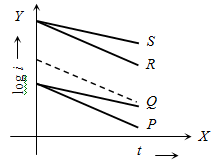
In an $RC$ circuit while charging, the graph of in $i$ versus time is as shown by the dotted line in the diagram figure, where $i$ is the current. When the value of the resistance is doubled, which of the solid curve best represents the variation of in $i$ versus time
The Electric flux through the surface:
A parallel plate capacitor has capacitance $C.$ If it is equally filled with parallel layers of materials of dielectric constants $K_1$ and $K_2$ its capacity becomes $C_1$. The ratio of $C_1$ to $C $ is
Study involving both electricity and magnetism is called ______.
Out of the following which one is not a possible energy for a photon to be emitted by hydrogen atom according to Bohr’s atomic model?
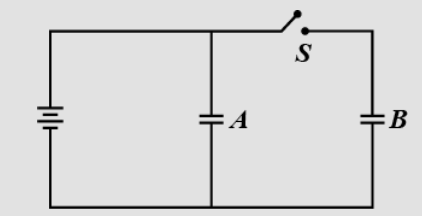
Two identical air filled parallel plate capacitors are charged to the same potential in the manner shown by closing the switch $S.$ If now the switch $S$ is opened and the space between the plates is filled with a dielectric of relative permittivity $ε_{r​},$ then:
The patient is asked to drink $\mathrm{BaSO}_4$ tor examining the stomach by $X-$rays because $X-$rays are