Two identical plates of different metals are joined to form a single plate whose thickness is double the thickness of each plate. If the coefficients of conductivity of each plate are $2$ and $3$ respectively, then the conductivity of composite plate will be
Medium


Download our appand get started for free
Experience the future of education. Simply download our apps or reach out to us for more information. Let's shape the future of learning together!No signup needed.*
Similar Questions
- 1Two sphere of radius $R_1$ and $R_2$ have densities ${\rho _1}$ and ${\rho _2}$ and specific heat $S_1$ and $S_2$ if they are heated to the same temperature the ratio of their rates of falling temperature will beView Solution
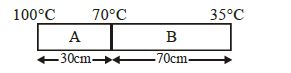
- 2Two different rods $A$ and $B$ are kept as shown in figure. The ratio of thermal conductivities of $A$ and $B$ isView Solution
- 3A black body at $1227^o C$ emits radiations with maximum intensity at a wavelength of $5000\;\mathring A$ . If the temperature of the body is increased by $1000^o C$, the maximum intensity will be observed at ...... $\mathring A$View Solution
- 4A black body of surface area $10cm^2$ is heated to $127°C$ and is suspended in a room at temperature $27°C$ . The initial rate of loss of heat from the body at the room temperature will be ...... $W$View Solution
- 5The temperature gradient in a rod of $0.5 m$ long is ${80^o}C/m$. If the temperature of hotter end of the rod is ${30^o}C$, then the temperature of the cooler end is ...... $^oC$View Solution
- 6The end $A$ of a rod $AB$ of length $1\,m$ is maintained at $80\,^oC$ and the end $B$ at $0\,^oC.$ The temperature at a distance of $60\,\,c.m.$ from the end $A$ is......... $^oC$View Solution
- 7he ratio of the coefficient of thermal conductivity of two different materials is $5 : 3$ . If the thermal resistance of the rod of same thickness resistance of the rods of same thickness of these materials is same, then the ratio of the length of these rods will beView Solution
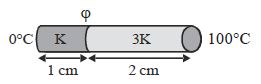
- 8Two bars of thermal conductivities $K$ and $3K$ and lengths $1\,\, cm$ and $2\,\, cm$ respectively have equal cross-sectional area, they are joined lengths wise as shown in the figure. If the temperature at the ends of this composite bar is $0\,^oC$ and $100\,^oC$ respectively (see figure), then the temperature $\varphi $ of the interface is......... $^oC$View Solution
- 9The 'Kangri' is an earthen pot used to stay warm in Kashmir during the winter months. Assume that the 'Kangri' is spherical and of surface area $7 \times 10^{-2} \,m ^{2}$. It contains $300 g$ of a mixture of coal, wood and leaves with calorific value of $30 \,kJ / g$ (and provides heat with $10 \%$ efficiency). The surface temperature of the 'Kangri' is $60^{\circ} C$ and the room temperature is $0^{\circ} C$. Then, a reasonable estimate for the duration $t$ (in h) that the 'Kangri' heat will last is (take the 'Kangri' to be a black body)View Solution
- 10The radiation emitted by a star $A$ is $10,000$ times that of the sun. If the surface temperatures of the sun and the star $A$ are $6000 K$ and $2000 K$ respectively, the ratio of the radii of the star $A$ and the sun isView Solution