If $3$ charges are placed at the vertices of equilateral triangle of charge ‘$q$’ each. What is the net potential energy, if the side of equilateral triangle is $l\, cm$
Easy
Download our app for free and get started
(c) $U = \frac{1}{{4\pi {\varepsilon _0}}}.\frac{{{Q_1}{Q_2}}}{r};$ net potential energy
${U_{net}} = 3 \times \frac{1}{{4\pi {\varepsilon _0}}}.\frac{{{q^2}}}{l}$
${U_{net}} = 3 \times \frac{1}{{4\pi {\varepsilon _0}}}.\frac{{{q^2}}}{l}$

Download our appand get started for free
Experience the future of education. Simply download our apps or reach out to us for more information. Let's shape the future of learning together!No signup needed.*
Similar Questions
- 1A series combination of three capacitors of capacities $1\,\mu \,F,\,2\,\mu \,F$ and $8\,\mu \,F$ is connected to a battery of $e.m.f.$ $13\, volt$. The potential difference across the plates of $2\,\mu \,F$ capacitor will be.....$V$View Solution
- 2View SolutionDuring charging and discharging of a capacitor
- 3A disk of radius $R$ with uniform positive charge density $\sigma$ is placed on the $x y$ plane with its center at the origin. The Coulomb potential along the $z$-axis isView Solution
$V(z)=\frac{\sigma}{2 \epsilon_0}\left(\sqrt{R^2+z^2}-z\right)$
A particle of positive charge $q$ is placed initially at rest at a point on the $z$ axis with $z=z_0$ and $z_0>0$. In addition to the Coulomb force, the particle experiences a vertical force $\vec{F}=-c \hat{k}$ with $c>0$. Let $\beta=\frac{2 c \epsilon_0}{q \sigma}$. Which of the following statement($s$) is(are) correct?
$(A)$ For $\beta=\frac{1}{4}$ and $z_0=\frac{25}{7} R$, the particle reaches the origin.
$(B)$ For $\beta=\frac{1}{4}$ and $z_0=\frac{3}{7} R$, the particle reaches the origin.
$(C)$ For $\beta=\frac{1}{4}$ and $z_0=\frac{R}{\sqrt{3}}$, the particle returns back to $z=z_0$.
$(D)$ For $\beta>1$ and $z_0>0$, the particle always reaches the origin.
- 4Given,View Solution
${R_1} = 1\,\Omega $ $C_1 \,= 2\,\mu F$
${R_2} = 2\,\Omega $ $C_2 \,= 4\,\mu F$
The time constants ( in $\mu\, s$) for the circuits $I, II, III$ are respectively
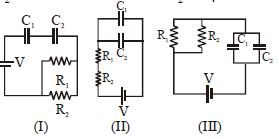
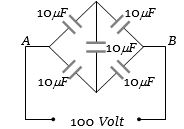
- 5Five capacitors of $10\,\mu F$ capacity each are connected to a $d.c.$ potential of $100\;volts$ as shown in the adjoining figure. The equivalent capacitance between the points $A$ and $B$ will be equal to..........$\mu F$View Solution
- 6Ten capacitor are joined in parallel and charged with a battery up to a potential $V$. They are then disconnected from battery and joined again in series then the potential of this combination will be.......$V$View Solution
- 7View SolutionA parallel plate air capacitor is charged and then isolated. When a dielectric material is inserted between the plates of the capacitor, then which of the following does not change
- 8The electric potential $V(x)$ in a region around the origin is given by $V(x) = 4x^2\,volts$ . The electric charge enclosed in a cube of $1\,m$ side with its centre at the origin is (in coulomb)View Solution
- 9The gap between the plates of a parallel plate capacitor of area $A$ and distance between plates $d$, is filled with a dielectric whose permittivity varies linearly from ${ \varepsilon _1}$ at one plate to ${ \varepsilon _2}$ at the other. The capacitance of capacitor isView Solution
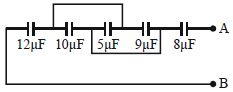
- 10Five capacitors together with their capacitances are shown in the adjoining figure. The potential difference between the points $A$ and $B$ is $60\, volt$. The equivalent capacitance between the point $A$ and $B$ and charge on capacitor $5 \mu F$ will be respectively:-View Solution