Two identical thin metal plates has charge $q _{1}$ and $q _{2}$ respectively such that $q _{1}> q _{2}$. The plates were brought close to each other to form a parallel plate capacitor of capacitance $C$. The potential difference between them is.
JEE MAIN 2022, Medium


Download our appand get started for free
Experience the future of education. Simply download our apps or reach out to us for more information. Let's shape the future of learning together!No signup needed.*
Similar Questions
- 1Two capacitors $C_1$ and $C_2$ are charged to $120\ V$ and $200\ V$ respectively. It is found that connecting them together the potential on each one can be made zero. ThenView Solution
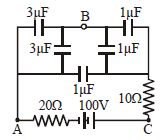
- 2In the figure below, what is the potential difference between the points $A$ and $B$ and between $B$ and $C$ respectively in steady stateView Solution
- 3Two charged particles of masses $m$ and $2m$ have charges $+2q$ and $+q$ respectively. They are kept in uniform electric field and allowed to move for some time. The ratio of their kinetic energies will beView Solution
- 4A $6\,\mu F$ capacitor is charged from $10\;volts$ to $20\;volts$. Increase in energy will beView Solution
- 5Conduction electrons are almost uniformly distributed within a conducting plate. When placed in an electrostatic field $\overrightarrow E $, the electric field within the plateView Solution
- 6The electric potential at a point in free space due to charge $Q$ coulomb is $V=Q$$ \times {10^{11}}\,V$ . The electric field at that point isView Solution
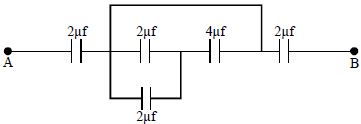
- 7Find the equivalent capacitance between $A$ and $B$.......$\mu f$View Solution
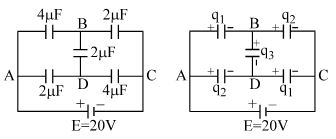
- 8The value of charge $q_1, q_2$ and $q_3$ as shown in the figure areView Solution
- 9There exists a uniform electric field $E=4 \times 10^5 \,Vm ^{-1}$ directed along negative $x$-axis such that electric potential at origin is zero. Acharge of $-200 \,\mu C$ is placed at origin, and a charge of $+200 \,\mu C$ is placed at $(3 \,m , 0)$. The electrostatic potential energy of the system is ...........$J$View Solution
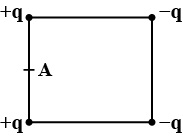
- 10Four electric charges $+q,+q, -q$ and $-q$ are placed at the comers of a square of side $2L$ (see figure). The electric potential at point $A,$ midway between the two charges $+q$ and $+q,$ isView Solution