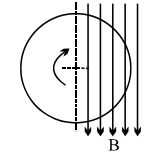
A small coil of $N$ $turns$ has an effective area $A$ and carries a current $I$. It is suspended in a horizontal magnetic field $\overrightarrow B $ such that its plane is perpendicular to $\overrightarrow B $. The work done in rotating it by $180^\circ $ about the vertical axis is
Medium
Download our app for free and get started
(b) $W = MB\left( {\cos {\theta _1} - \cos {\theta _2}} \right)$
$ = (NiA)\;B(\cos 0^\circ - \cos 180^\circ ) = 2NAIB$
$ = (NiA)\;B(\cos 0^\circ - \cos 180^\circ ) = 2NAIB$

Download our appand get started for free
Experience the future of education. Simply download our apps or reach out to us for more information. Let's shape the future of learning together!No signup needed.*
Similar Questions
- 1A galvanometer is used in laboratory for the null point in electrical experiments. If, on passing a current of $6 \,m A$ it produces a deflection of $2^{\circ},$ its figure of merit is close to :View Solution
- 2At what distance on the axis, from the centre of a circular current carrying coil of radius $r$, the magnetic field becomes $1 / 8$ th of the magnetic field at centre?View Solution
- 3A thin rod is bent in the shape of a small circle of radius $'r'$. If the charge per unit length of the rod is $'\sigma ',$ and if the circle is rotated about its axis at the rate of $'n'$ rotation per second, the magnetic induction at a point on the axis at a large distance $'y'$ from the centre isView Solution
- 4A long wire carries a steady current. It is bent into a circle of one turn and the magnetic field at the centre of the coil is $B$. It is then bent into a circular loop of $n$ $turns$. The magnetic field at the centre of the coil will beView Solution
- 5A charged particle moves along circular path in a uniform magnetic field in a cyclotron. The kinetic energy of the charged particle increases to $4$ times its initial value. What will be the ratio of new radius to the original radius of circular path of the charged particleView Solution
- 6A wire in the form of a square of side ‘$a$’ carries a current $i$. Then the magnetic induction at the centre of the square wire is (Magnetic permeability of free space =${\mu _o}$)View Solution
- 7An ionized gas contains both positive and negative ions. If it is subjected simultaneously to an electric field along the $+x$ direction and a magnetic field along the $+z$ direction, thenView Solution
- 8A $50\,\Omega $ resistance is connected to a battery of $5\,V$. A galvanometer of resistance $100\, \Omega $ is to be used as an ammeter to measure current through the resistance, for this a resistance $r_s$ is connected to the galvanometer. Which of the following connections should be employed if the measured current is within $1\% $ of the current without the ammeter in the circuit ?View Solution
- 9The field normal to the plane of a wire of $n$ turns and radius $r$ which carries a current $i$ is measured on the axis of the coil at a small distance $h$ from the centre of the coil. This is smaller than the field at the centre by the fractionView Solution
- 10A thin non conducting disc of radius $R$ is rotating clockwise (see figure) with an angular velocity $w$ about its central axis, which is perpendicular to its plane. Both its surfaces carry $+ve$ charges of uniform surface density. Half the disc is in a region of a uniform, unidirectional magnetic field $B$ parallel to the plane of the disc, as shown. Then,View Solution