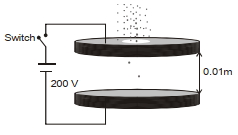
Two large circular discs separated by a distance of $0.01 m$ are connected to a battery via a switch as shown in the figure. Charged oil drops of density $900 kg m ^{-3}$ are released through a tiny hole at the center of the top disc. Once some oil drops achieve terminal velocity, the switch is closed to apply a voltage of $200 V$ across the discs. As a result, an oil drop of radius $8 \times 10^{-7} m$ stops moving vertically and floats between the discs. The number of electrons present in this oil drop is (neglect the buoyancy force, take acceleration due to gravity $=10 ms ^{-2}$ and charge on an electron ($e$) $=1.6 \times 10^{-19} C$ )
IIT 2020, Medium


Download our appand get started for free
Experience the future of education. Simply download our apps or reach out to us for more information. Let's shape the future of learning together!No signup needed.*
Similar Questions
- 1An electric charge $10^{-3}\ \mu C$ is placed at the origin $(0, 0)$ of $X-Y$ coordinate system. Two points $A$ and $B$ are situated at $(\sqrt 2 ,\sqrt 2 )$ and $(2, 0)$ respectively. The potential difference between the points $A$ and $B$ will be......$V$View Solution
- 2A parallel plate condenser with oil between the plates (dielectric constant of oil $K = 2$) has a capacitance $C$. If the oil is removed, then capacitance of the capacitor becomesView Solution
- 3View SolutionAssertion : In a cavity within a conductor, the electric field is zero.
Reason : Charges in a conductor reside only at its surface
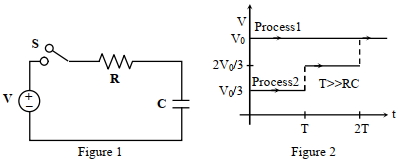
- 4Consider a simple $RC$ circuit as shown in Figure $1$.View Solution
Process $1$: In the circuit the switch $S$ is closed at $t=0$ and the capacitor is fully charged to voltage $V_0$ (i.e. charging continues for time $T \gg R C$ ). In the process some dissipation ( $E_D$ ) occurs across the resistance $R$. The amount of energy finally stored in the fully charged capacitor is $EC$.
Process $2$: In a different process the voltage is first set to $\frac{V_0}{3}$ and maintained for a charging time $T \gg R C$. Then the voltage is raised to $\frac{2 \mathrm{~V}_0}{3}$ without discharging the capacitor and again maintained for time $\mathrm{T} \gg \mathrm{RC}$. The process is repeated one more time by raising the voltage to $V_0$ and the capacitor is charged to the same final
take $\mathrm{V}_0$ as voltage
These two processes are depicted in Figure $2$.
($1$) In Process $1$, the energy stored in the capacitor $E_C$ and heat dissipated across resistance $E_D$ are released by:
$[A]$ $E_C=E_D$ $[B]$ $E_C=E_D \ln 2$ $[C]$ $\mathrm{E}_{\mathrm{C}}=\frac{1}{2} \mathrm{E}_{\mathrm{D}}$ $[D]$ $E_C=2 E_D$
($2$) In Process $2$, total energy dissipated across the resistance $E_D$ is:
$[A]$ $\mathrm{E}_{\mathrm{D}}=\frac{1}{2} \mathrm{CV}_0^2$ $[B]$ $\mathrm{E}_{\mathrm{D}}=3\left(\frac{1}{2} \mathrm{CV}_0^2\right)$ $[C]$ $\mathrm{E}_{\mathrm{D}}=\frac{1}{3}\left(\frac{1}{2} \mathrm{CV}_0^2\right)$ $[D]$ $\mathrm{E}_{\mathrm{D}}=3 \mathrm{CV}_0^2$
Given the answer quetion ($1$) and ($2$)
- 5A spherical charged conductor has surface charge density $\sigma $ . The electric field on its surface is $E$ and electric potential of conductor is $V$ . Now the radius of the sphere is halved keeping the charge to be constant. The new values of electric field and potential would beView Solution
- 6View SolutionA parallel plate air-core capacitor is connected across a source of constant potential difference. When a dielectric plate is introduced between the two plates then :
- 7The plates of a parallel plate condenser are pulled apart with a velocity $v$. If at any instant their mutual distance of separation is $d$, then the magnitude of the time of rate of change of capacity depends on $d$ as followsView Solution
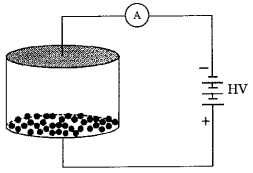
- 8Consider an evacuated cylindrical chamber of height $h$ having rigid conducting plates at the ends and an insulating curved surface as shown in the figure. A number of spherical balls made of a light weight and soft material and coated with a conducting material are placed on the bottom plate. The balls have a radius $r \ll h$. Now a high voltage source ($HV$) is connected across the conducting plates such that the bottom plate is at $+V_0$ and the top plate at $-V_0$. Due to their conducting surface, the balls will get charged, will become equipotential with the plate and are repelled by it. The balls will eventually collide with the top plate, where the coefficient of restitution can be taken to be zero due to the soft nature of the material of the balls. The electric field in the chamber can be considered to be that of a parallel plate capacitor. Assume that there are no collisions between the balls and the interaction between them is negligible. (Ignore gravity)View Solution
(image)
($1$) Which one of the following statements is correct?
($A$) The balls will stick to the top plate and remain there
($B$) The balls will bounce back to the bottom plate carrying the same charge they went up with
($C$) The balls will bounce back to the bottom plate carrying the opposite charge they went up with
($D$) The balls will execute simple harmonic motion between the two plates
($2$) The average current in the steady state registered by the ammeter in the circuit will be
($A$) zero
($B$) proportional to the potential $V_0$
($C$) proportional to $V_0^{1 / 2}$
($D$) proportional to $V_0^2$
Give the answer quetion ($1$) and ($2$)
- 9Electric charges having same magnitude of electricicharge $q$ coulombs are placed at $x=1 \,m , 2 \,m , 4 \,m$, $8 \,m$....... so on. If any two consecutive charges have opposite sign but the first charge is necessarily positive, what will be the potential at $x=0$ ?View Solution
- 10Two identical capacitors are joined in parallel, charged to potential $V$, separated and then, connected in series, $i.e.$, the positive plate of one is connected to the negative plate of the other. ThenView Solution