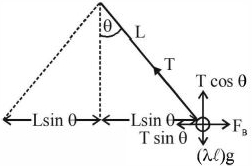
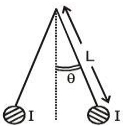
Two long current carrying thin wires, both with current $I$, are held by insulating threads oflength $L$ and are in equilibrium as shown in the figure, with threads making an angle '$\theta$' with the vertical. If wires have mass $\lambda$ per unit length then the value of $l$ is 
($g =$ gravitational acceleration)
JEE MAIN 2015, Diffcult
Download our app for free and get startedPlay store
Let us consider $'l'$ length of current carrying wire. 

At equilibrium

$\mathrm{T} \cos \theta=\lambda \mathrm{g} \ell$

and $T \sin \theta=\frac{\mu_{0}}{2 \pi} \frac{I \times I l}{2 L \sin \theta}\left[\because \frac{F_{B}}{\ell}=\frac{\mu_{0}}{4 \pi} \frac{2 I \times I}{2 \ell \sin \theta}\right]$

Therefore, $I=2 \sin \theta \sqrt{\frac{\pi \lambda g L}{u_{0} \cos \theta}}$

art

Download our app
and get started for free

Experience the future of education. Simply download our apps or reach out to us for more information. Let's shape the future of learning together!No signup needed.*

Similar Questions

  • 1
    Find the magnitude of magnetic field at point $p$ due to a semi - infinite wire given below
    View Solution
  • 2
    The magnitude of the magnetic field at the centre of an equilateral triangular loop of side $1\,m$ which is carrying a current of $10\,A$ is:......$\mu T$ [Take $\mu _0 = 4\pi  \times 10^{-7}\,NA^{-2}$]
    View Solution
  • 3
    The shape of the magnetic field lines due to an infinite long, straight current carrying conductor is :
    View Solution
  • 4
    Given below are two statements$:$

    Statement $I:$ Biot-Savart's law gives us the expression for the magnetic field strength of an infinitesimal current element (IdI) of a current carrying conductor only.

    Statement $II :$ Biot-Savart's law is analogous to Coulomb's inverse square law of charge $q$, with the former being related to the field produced by a scalar source, Idl while the latter being produced by a vector source, $q$. In light of above statements choose the most appropriate answer from the options given below:

    View Solution
  • 5
    A proton carrying $1\, Me V$ kinetic energy is moving in a circular path of radius $R$ in uniform magnetic field. What should be the energy of an $\alpha -$ particle to describe a circle of same radius in the same field ?........$MeV$
    View Solution
  • 6
    A wire of length $L$ metre carrying a current of $I$ ampere is bent in the form of circle. Its magnetic moment is
    View Solution
  • 7
    Two particles $A$ and $B$ of masses ${m_A}$ and ${m_B}$ respectively and having the same charge are moving in a plane. A uniform magnetic field exists perpendicular to this plane. The speeds of the particles are ${v_A}$ and ${v_B}$ respectively, and the trajectories are as shown in the figure. Then
    View Solution
  • 8
    A magnetic field can be produced by
    View Solution
  • 9
    The force exerted by a magnetic field on a wire having length $L$ and current $I$ is perpendicular to the wire and given as $\left| F \right| = IL\left| B \right|$ . An experimental plot shows $(\vec F)$ as function of $L$ . The plot is a straight line with a slope $S = \left( {10 \pm 1} \right) \times {10^{ - 5}}\ AT$. The current in the wire is $\left( {15 \pm 1} \right)\ mA$ . The percentage error in $B$ is
    View Solution
  • 10
    A current $I$ flows around a closed path in the horizontal plane of the circle as shown in the figure. The path consists of eight arcs with alternating radii $r$ and $2r$. Each segment of arc subtends equal angle at the common centre $P.$ The magnetic field produced by current path at point $P$ is
    View Solution