A proton carrying $1\, Me V$ kinetic energy is moving in a circular path of radius $R$ in uniform magnetic field. What should be the energy of an $\alpha -$ particle to describe a circle of same radius in the same field ?........$MeV$
AIPMT 2012, Diffcult
Download our app for free and get started
Kinetic energy of a charged particle,
$K=\frac{1}{2} m v^{2} \text { or } v=\sqrt{\frac{2 K}{m}}$
Radius of the circular path of a charged particle in uniform magnetic field is given by
$R=\frac{m v}{B q}=\frac{m}{B q} \sqrt{\frac{2 K}{m}}=\frac{\sqrt{2 m K}}{B q}$
Mass of a proton, $m_{p}=m$
Mass of an $\alpha$ -particle, $m_{\alpha}=4 m$
Charge of a proton, $q_{p}=e$
Charge of an $\alpha$ -particle, $q_{\alpha}=2 e$
$\therefore \quad R_{p}=\frac{\sqrt{2 m_{p} K_{p}}}{B q_{p}}=\frac{\sqrt{2 m K_{p}}}{B e}$
and $R_{\alpha}=\frac{\sqrt{2 m_{\alpha} K_{\alpha}}}{B q_{\alpha}}=\frac{\sqrt{2(4 m) K_{\alpha}}}{B(2 e)}=\frac{\sqrt{2 m K_{\alpha}}}{B e}$
$\therefore \quad \frac{R_{p}}{R_{\alpha}}=\sqrt{\frac{K_{p}}{K_{\alpha}}}$
As $R_{p}=R_{\alpha}$ (given) $\therefore K_{\alpha}=K_{p}=1\, \mathrm{MeV}$

Download our appand get started for free
Experience the future of education. Simply download our apps or reach out to us for more information. Let's shape the future of learning together!No signup needed.*
Similar Questions
- 1A solenoid of $1000$ turns per metre has a core with relative permeability $500$. Insulated windings of the solenoid carry an electric current of $5\, A$. The magnetic flux density produced by the solenoid isView Solution
(permeability of free space $\left.=4 \pi \times 10^{-7} H / m \right)$
- 2A wire carrying current $I$ and other carrying $2I$ in the same direction produces a magnetic field $B$ at the mid point. What will be the field when $2I$ wire is switched offView Solution
- 3The correct curve between the magnetic induction $(B)$ along the axis of a long solenoid due to current flow $i$ in it and distance $x$ from one end is :View Solution
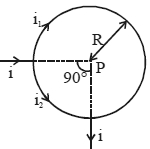
- 4A straight conductor carrying current $i$ splits into two parts as shown in the figure. The radius of the circular loop is $R$. The total magnetic field at the centre $P$ of the loop isView Solution
- 5An electron is moving with a speed of ${10^8}\,m/\sec $ perpendicular to a uniform magnetic field of intensity $B$. Suddenly intensity of the magnetic field is reduced to $B/2$. The radius of the path becomes from the original value of $r$View Solution
- 6Currents of a $10\, ampere$ and $2\, ampere$ are passed through two parallel thin wires $A$ and $B$ respectively in opposite directions. Wire $A$ is infinitely long and the length of the wire $B$ is $2\, m$. The force acting on the conductor $B$, which is situated at $10\, cm$ distance from $A$ will beView Solution
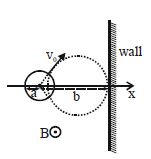
- 7An electron is projected normally from the surface of a sphere with speed $v_0$ in a uniform magnetic field perpendicular to the plane of the paper such that its strikes symmetrically opposite on the sphere with respect to the $x-$ axis. Radius of the sphere is $'a'$ and the distance of its centre from the wall is $'b'$ . What should be magnetic field such that the charge particle just escapes the wallView Solution
- 8A particle having a mass of $10^{- 2} \,kg$ carries a charge of $5 \times 10^{-8}\, C.$ The particle is given an initial horizontal velocity of $10^5\, m/s $ in the presence of electric field $E$ and magnetic field $B.$ To keep the particle moving in a horizontal direction, it is necessary thatView Solution
$(1)$ $\vec B$ should be perpendicular to the direction of velocity and $\vec E$ should be along the direction of velocity$(2)$ Both $\vec B$ and $\vec E$ should be along the direction of velocity$(3)$ Both $\vec B$ and $\vec E$ are mutually perpendicular and perpendicular to the direction of velocity.$(4)$ $\vec B$ should be along the direction of velocity and $\vec E$ should be perpendicular to the direction of velocityWhich one of the following pairs of statements is possible? - 9A voltmeter has a resistance of $G\, ohms$ and range $V\, volts$. The value of resistance used in series to convert it into a voltmeter of range $nV$ $volts$ isView Solution
- 10Two long parallel wires carrying currents $8\,A$ and $15\,A$ in opposite directions are placed at a distance of $7\,cm$ from each other. A point $P$ is at equidistant from both the wires such that the lines joining the point $P$ to the wires are perpendicular to each other. The magnitude of magnetic field at $P$ is $............\times 10^{-6}\,T$. (Given : $\left.\sqrt{2}=1.4\right)$View Solution