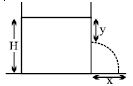
Acylindrical vessel is filled with a liquid up to height H.A small hole is made in the vessel at a distance $y$ below the liquid surface as shown in figure. The liquid emerging from the hole strike the ground at distance $x$
Diffcult
Download our app for free and get started
$x$ is max if $y=\frac{H}{2}$ $\& \max x=H$
Hence
option $B$ is correct answer.

Download our appand get started for free
Experience the future of education. Simply download our apps or reach out to us for more information. Let's shape the future of learning together!No signup needed.*
Similar Questions
- 1Water is moving with a speed of $5.18 ms^{-1}$ through a pipe with a cross-sectional area of $4.20 cm^2$. The water gradually descends $ 9.66 m $ as the pipe increase in area to $7.60 cm^2$. The speed of flow at the lower level is ....... $ms^{-1}$View Solution
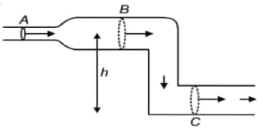
- 2Water is flowing through a channel (lying in a vertical plane) as shown in the figure. Three sections $A, B$ and $C$ are shown. Sections $B$ and $C$ have equal area of cross section. If $P_A, P_B$ and $P_C$ are the pressures at $A, B$ and $C$ respectively thenView Solution
- 3A $0.5\ kg$ mass of lead is submerged in a container filled to the brim with water and a block of wood floats on top. The lead mass is slowly lifted from the container by a thin wire and as it emerges into air the level of the water in the container drops a bit. The lead mass is now placed on the block of wood. As the lead is placed on the wood.View Solution
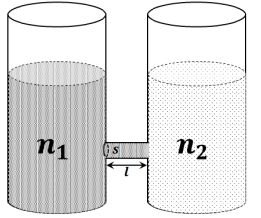
- 4As shown schematically in the figure, two vessels contain water solutions (at temperature $T$ ) of potassium permanganate $\left( KMnO _4\right)$ of different concentrations $n_1$ and $n_2\left(n_1>n_2\right)$ molecules per unit volume with $\Delta n=\left(n_1-n_2\right) \ll n_1$. When they are connected by a tube of small length $\ell$ and cross-sectional area $S , KMnO _4$ starts to diffuse from the left to the right vessel through the tube. Consider the collection of molecules to behave as dilute ideal gases and the difference in their partial pressure in the two vessels causing the diffusion. The speed $v$ of the molecules is limited by the viscous force $-\beta v$ on each molecule, where $\beta$ is a constant. Neglecting all terms of the order $(\Delta n)^2$, which of the following is/are correct? ( $k_B$ is the Boltzmann constant)-View Solution
$(A)$ the force causing the molecules to move across the tube is $\Delta n k_B T S$
$(B)$ force balance implies $n_1 \beta v \ell=\Delta n k_B T$
$(C)$ total number of molecules going across the tube per sec is $\left(\frac{\Delta n}{\ell}\right)\left(\frac{k_B T}{\beta}\right) S$
$(D)$ rate of molecules getting transferred through the tube does not change with time
- 5Water flows in a streamlined manner through a capillary tube of radius $a$, the pressure difference being $P$ and the rate of flow $Q$. If the radius is reduced to $a/2$ and the pressure increased to $ 2P, $ the rate of flow becomesView Solution
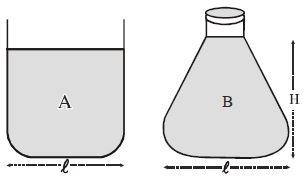
- 6Two vessels $A$ and $B$ have the same base area and contain water to the same height, but the mass of water in $A$ is four times that in $B$. The ratio of the liquid thrust at the base of $A$ to that at the base of $B$ isView Solution
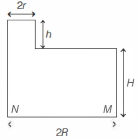
- 7A cylindrical vessel of base radius $R$ and height $H$ has a narrow neck of height $h$ and radius $r$ at one end (see figure). The vessel is filled with water (density $\rho_w$ ) and its neck is filled with immiscible oil (density $\rho_0$ ). Then, the pressure atView Solution
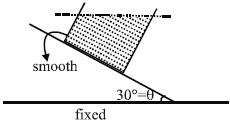
- 8A container of liquid release from the rest, on a smooth inclined plane as shown in the figure. Length of at the inclined plane is sufficient, and assume liquid finally equilibrium. Finally liquid surface makes an angle with horizontal ...... $^o$View Solution
- 9Three capillaries of length $L, \frac{L}{2}$ and $\frac{L}{3}$ are connected in series. Their radii are $r, \frac{r}{2}$ and $\frac{r}{3}$ respectively. Then if stream-line flow is to be maintained and the pressure across the first capillary is $P$, then ............View Solution
- 10The terminal velocity of a small sphere of radius $a$ in a viscous liquid is proportional toView Solution