A current carrying wire of length $L$ is transformed into a coil of $N$ turns. To achieve maximum magnetic moment, the coil
Medium
Download our app for free and get started
$M=\mathbf{N I} A$
$\mathrm{M}=\mathrm{N} \times \mathrm{I} \times \mathrm{n} \mathrm{R}^{2}$
$\mathrm{M}=\mathrm{N} \times \mathrm{I} \times \mathrm{N} \times \frac{\mathrm{L}^{2}}{4 \mathrm{n}^{2} \mathrm{N}^{2}}$
$\mathrm{L}=\mathrm{N} \times 2 \mathrm{nR}$
$\Rightarrow \mathrm{R}=\frac{\mathrm{L}}{2 \mathrm{nN}} \quad \mathrm{M} \times \frac{1}{\mathrm{N}}$
For $M_{\max } N=1$ and area of circle is maximum

Download our appand get started for free
Experience the future of education. Simply download our apps or reach out to us for more information. Let's shape the future of learning together!No signup needed.*
Similar Questions
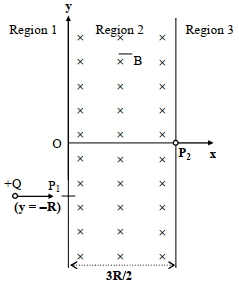
- 1A uniform magnetic field $B$ exists in the region between $x=0$ and $x=\frac{3 R}{2}$ (region $2$ in the figure) pointing normally into the plane of the paper. A particle with charge $+Q$ and momentum $p$ directed along $x$-axis enters region $2$ from region $1$ at point $P_1(y=-R)$. Which of the following option(s) is/are correct?View Solution
$[A$ For $B>\frac{2}{3} \frac{p}{QR}$, the particle will re-enter region $1$
$[B]$ For $B=\frac{8}{13} \frac{\mathrm{p}}{QR}$, the particle will enter region $3$ through the point $P_2$ on $\mathrm{x}$-axis
$[C]$ When the particle re-enters region 1 through the longest possible path in region $2$ , the magnitude of the change in its linear momentum between point $P_1$ and the farthest point from $y$-axis is $p / \sqrt{2}$
$[D]$ For a fixed $B$, particles of same charge $Q$ and same velocity $v$, the distance between the point $P_1$ and the point of re-entry into region $1$ is inversely proportional to the mass of the particle
- 2A galvanometer of resistance $25\,\Omega $ gives full scale deflection for a current of $10$ milliampere, is to be changed into a voltmeter of range $100\, V$ by connecting a resistance of $‘R’$ in series with galvanometer. The value of resistance $R$ in $\Omega $ isView Solution
- 3View SolutionIf we double the radius of a coil keeping the current through it unchanged, then the magnetic field at any point at a large distance from the centre becomes approximately
- 4At a specific instant emission of radioactive compound is deflected in a magnetic field. The compound can emitView Solution
$(i)$ Electrons $(ii)$ Protons $(iii)$ $H{e^{2 + }}$ $(iv)$ Neutrons
The emission at the instant can be
- 5A proton moving with a constant velocity passes through a region of space without any change in its velocity. If $\overrightarrow E $ and $\overrightarrow B $ represent the electric and magnetic fields respectively, then this region of space may haveView Solution
- 6One proton beam enters a magnetic field of ${10^{ - 4}}$ $T$ normally, Specific charge = ${10^{11}}\,C/kg.$ velocity = ${10^7}\,m/s$. What is the radius of the circle described by it....$m$View Solution
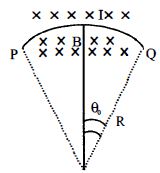
- 7A wire carrying current $I$ is tied between points $P$ and $Q$ and is in the shape of a circular arc of radius $R$ due to a uniform magnetic field $B$ (perpendicular to the plane of the paper, shown by $\times \times \times $) in the vicinity of the wire. If the wire subtends an angle $2\theta_0$ at the centre of the circle (of which it forms an arc) then the tension in the wire isView Solution
- 8A square coil of side $10\; cm$ consists of $20$ turns and carries a current of $12\; A$. The coil is suspended vertically and the normal to the plane of the coil makes an angle of $30^o$ with the direction of a uniform horizontal magnetic field of magnitude $0.80 \;T$. What is the magnitude of torque (in $N\;m$) experienced by the coil?View Solution
- 9A moving coil galvanometer is converted into an ammeter reading upto $0.03\,A$ by connecting a shunt of resistance $4r$ across it and into an ammeter reading upto $0.06\,A$ when a shunt of resistance $r$ is connected across it. What is the maximum current which can be sent through this galvanometer if no shunt is used ............... $A$View Solution
- 10A long straight wire of radius a carries a steady current I. The current is uniformly distributed across its cross section. The ratio of the magnetic field at $\frac{a}{2}$ and $2$a from axis of the wire is:View Solution