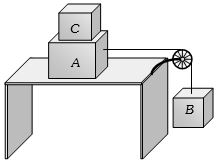
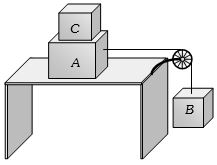
Two masses $A$ and $B$ of $10\, kg$ and $5 \,kg$ respectively are connected with a string passing over a frictionless pulley fixed at the corner of a table as shown. The coefficient of static friction of $A$ with table is $0.2$. The minimum mass of $C$ that may be placed on $A$ to prevent it from moving is ........ $kg$
Medium


Download our appand get started for free
Experience the future of education. Simply download our apps or reach out to us for more information. Let's shape the future of learning together!No signup needed.*
Similar Questions
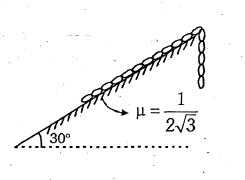
- 1A uniform chain is at rest partially on the incline and partially hanging vertically. Coefficient of friction between chain and incline is $\mu = \frac{1}{{2\sqrt 3 }}$. The ratio of $\frac{{{L_{\max }}}}{{{L_{\min }}}}$ is $(L_{max} =$ maximum length of chain kept on inclined so that chain remains at rest, $L_{min} =$ minimum length of chain kept on incline so that chain remains at rest)View Solution
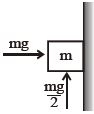
- 2View SolutionA block pressed against the vertical wall is in equilibrium. The minimum coefficient of friction is:-
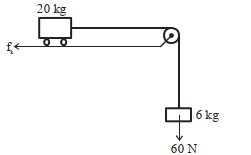
- 3Consider a block and trolley system as shown in figure. If the coefficient of kinetic friction between the trolley and the surface is $0.04$ , the acceleration of the system in $\mathrm{ms}^{-2}$ is :View Solution
(Consider that the string is massless and unstretchable and the pulley is also massless and frictionless):
- 4A person with his hand in his pocket is skating on ice at the rate of $10 m / s$ and describes a circle of radius $50 m$. What is his inclination to vertical: $\left( g =10 m / sec ^2\right)$View Solution
- 5Two masses $A$ and $B$ of $10\, kg$ and $5 \,kg$ respectively are connected with a string passing over a frictionless pulley fixed at the corner of a table as shown. The coefficient of static friction of $A$ with table is $0.2$. The minimum mass of $C$ that may be placed on $A$ to prevent it from moving is ........ $kg$View Solution
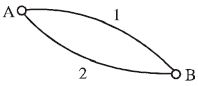
- 6A small body slips, subject to the force of friction, from point $A$ to point $B$ along two curved surfaces of equal radius, first along route $1,$ then along route $2$. Friction does not depend on the speed and the coefficient of friction on both routes is the same. In which case will the body’s speed at $B$ be greater?View Solution
- 7A car is moving on a circular path and takes a turn. If ${R_1}$ and ${R_2}$ be the reactions on the inner and outer wheels respectively, thenView Solution
- 8A block of mass $m$ is placed on a surface having vertical cross section given by $y=x^2 / 4$. If coefficient of friction is $0.5$ , the maximum height above the ground at which block can be placed without slipping is:View Solution
- 9A $\vec F\,\, = \,\,\hat i\, + \,4\hat j\,$ acts on block shown. The force of friction acting on the block is :View Solution
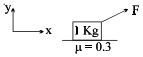
- 10A body of weight $64\, N$ is pushed with just enough force to start it moving across a horizontal floor and the same force continues to act afterwards. If the coefficients of static and dynamic friction are $0.6$ and $0.4$ respectively, the acceleration of the body will be (Acceleration due to gravity $= g$)View Solution