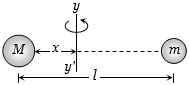
Two masses $M$ and $m$ are attached to a vertical axis by weightless threads of combined length $l$. They are set in rotational motion in a horizontal plane about this axis with constant angular velocity $\omega $. If the tensions in the threads are the same during motion, the distance of $M$ from the axis is
Diffcult


Download our appand get started for free
Experience the future of education. Simply download our apps or reach out to us for more information. Let's shape the future of learning together!No signup needed.*
Similar Questions
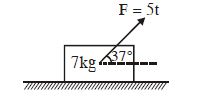
- 1A block of $7\,kg$ is placed on a rough horizontal surface and is pulled through a variable force $F$ (in $N$ ) $= 5\,t$ , where $'t'$ is time in second, at an angle of $37^o$ with the horizontal as shown in figure. The coefficient of static friction of the block with the surface is one. If the force starts acting at $t = 0\,s$ . Find the time at which the block starts to slide ......... $\sec$ (Take $g = 10\,m/s^2$ )View Solution
- 2View SolutionThe limiting friction is
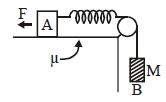
- 3Block $A$ of mass $m$ and block $B$ of mass $M$ are connected by a massless spring over a pulley on a rough plane with coefficient of friction as $μ$. A force $F$ is applied on block $A$ to the left. Find the minimum value of $M$ to move the block $A$ towards rightView Solution
- 4A railway line is taken round a circular arc of radius $1000\ m$ , and is banked by raising the outer rail $h$ $m$ above the inner rail. If the lateral force on the inner rail when a train travels round the curve at $10\ ms^{-1}$ is equal to the lateral force on the outer rail when the train's speed is $20\ ms^{-1}$ . The value of $4g\ tan\theta $ is equal to : (The distance between the rails is $1.5\ m$ )View Solution
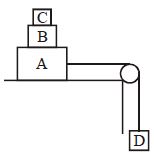
- 5Three blocks $A$, $B$ and $C$ of equal mass $m$ are placed on a smooth surface as shown. Coefficient of friction between any block $A, B$ and $C$ is $μ$. The maximum value of mass $D$ so the block $A, B$ & $C$ move without slipping over each other isView Solution
- 6A force $F = Kt$ (where $t$ is the time in seconds and $K = 2\, N/s$) is applied on $2 \,kg$ block at $t = 0$ as shown in the figure. The displacement of $8\ kg$ block till the time when $2\, kg$ block start slipping on $8\,kg$ block will be (coefficient of friction between $2\,kg$ block and $8\, kg$ block is $0.2$ and between $8\, kg$ block and surface is zero,View Solution
$g = 10m/s^2)$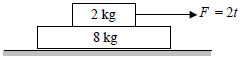
- 7A block of $1\, kg$ is stopped against a wall by applying a force $F$ perpendicular to the wall. If $\mu = 0.2$ then minimum value of $F$ will be ....... $N.$View Solution
- 8The normal reaction $'{N}^{\prime}$ for a vehicle of $800\, {kg}$ mass, negotiating a turn on a $30^{\circ}$ banked road at maximum possible speed without skidding is $...\,\times 10^{3}\, {kg} {m} / {s}^{2}$ [Given $\left.\cos 30^{\circ}=0.87, \mu_{{s}}=0.2\right]$View Solution
- 9A particle is moving in a circle of radius $R$ with constant speed $v$, if radius is double then its centripetal force to keep the same speed should beView Solution
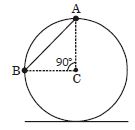
- 10Two beads connected by massless inextensible string are placed over the fixed ring as shown in figure. Mass of each bead is $m$ , and there is no friction between $B$ and ring. Find minimum value of coefficient of friction between $A$ and ring so that system remains in equilibrium. ( $C \to $center of ring, $AC$ line is vertical)View Solution