Question
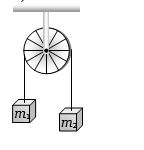
Two masses ${m_1}$ and ${m_2}$ are attached to a string which passes over a frictionless smooth pulley. When ${m_1} = 10kg,$ ${m_2} = 6kg,\,$the acceleration of masses is  .......... $m/s^{2}$
Answer

(c)$a = \left( {\frac{{{m_2} - {m_1}}}{{{m_1} + {m_2}}}} \right)g = \left( {\frac{{10 - 6}}{{10 + 6}}} \right) \times 10 = 2.5\,m/{s^2}$

Need a full question paper?

Generate a complete, print-ready paper with questions like this in minutes — across 16+ boards, with answer keys.
Start Generating Free

Similar questions

A particle with charge $+Q$ and mass m enters a magnetic field of magnitude $B,$ existing only to the right of the boundary $YZ$. The direction of the motion of the $m$ particle is perpendicular to the direction of $B.$ Let $T = 2\pi\frac{m}{{QB}}$ . The time spent by the particle in the field will be 
In a wave, the path difference corresponding to a phase difference of $ \phi$  is
For a particle in a uniformly accelerated circular motion
The time period of a simple pendulum measured inside a stationary lift is found to be $T$. If the lift starts accelerating upwards with an acceleration $g/3$, the time period is
The speed of a swimmer in still water is $20 \;\mathrm{m} / \mathrm{s}$. The speed of river water is $10\; \mathrm{m} / \mathrm{s}$ and is flowing due east. If he is standing on the south bank and wishes to cross the river along the shortest path, the angle at which he should make his strokes w.r.t. north is given by ......$^o$ west
Heat is flowing through a conductor of length l from $x = 0$ to $x = l$ . If its thermal resistance per unit length is uniform, which of the following graphs is correct
A pole is vertically submerged in swimming pool, such that it gives a length of shadow $2.15 \,m$ within water when sunlight is incident at an angle of $30^{\circ}$ with the surface of water. If swimming pool is filled to a height of $1.5\,m$, then the height of the pole above the water surface in centimetres is $\left(\eta_W=4 / 3\right)........$
Resistivity of a semiconductor depends on
Which of the following waves can not be polarised ?
The plates of a parallel plate condenser are pulled apart with a velocity $v$. If at any instant their mutual distance of separation is $d$, then the magnitude of the time of rate of change of capacity depends on $d$ as follows