Two metallic spheres of radii $1\,cm$ and $2\,cm$ are given charges ${10^{ - 2}}\,C$ and $5 \times {10^{ - 2}}\,C$ respectively. If they are connected by a conducting wire, the final charge on the smaller sphere is
AIPMT 1995, Medium
Download our app for free and get started
(d) ${Q_1} = {10^{ - 2}}C$, ${Q_2} = 5 \times {10^{ - 2}}\,C$
Total charge of the system $ Q = 6 \times {10^{ - 6}}\,C$
Charge on small sphere
$Q{'_1} = \frac{{Q\,{r_1}}}{{{r_1} + {r_2}}} = \frac{{6 \times {{10}^{ - 2}} \times 1}}{{1 + 2}} = 2 \times {10^{ - 2}}\,C$
Total charge of the system $ Q = 6 \times {10^{ - 6}}\,C$
Charge on small sphere
$Q{'_1} = \frac{{Q\,{r_1}}}{{{r_1} + {r_2}}} = \frac{{6 \times {{10}^{ - 2}} \times 1}}{{1 + 2}} = 2 \times {10^{ - 2}}\,C$

Download our appand get started for free
Experience the future of education. Simply download our apps or reach out to us for more information. Let's shape the future of learning together!No signup needed.*
Similar Questions
- 1A capacitor of capacitance $10\, mF$ is connected to a battery of emf $2\,V.$ It is found that it takes $50\, ms$ for the charge on the capacitor to become $12.6 \,mC.$ Then the resistance of the circuit is :.......$\, k \Omega$ (Take $1/e = 0.37$):-View Solution
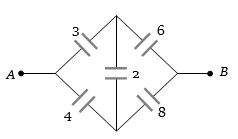
- 2Effective capacitance between $A$ and $B$ in the figure shown is (all capacitance are in $\mu F$)View Solution
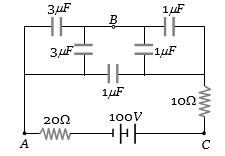
- 3In the figure below, what is the potential difference between the point $A$ and $B$ and between $B$ and $C$ respectively in steady stateView Solution
- 4An electron with an initial speed of $4.0 \times 10^6 \,ms ^{-1}$ is brought to rest by an electric field. The mass and charge of an electron are $9 \times 10^{-31} \,kg$ and $1.6 \times 10^{-19} \,C$, respectively. Identify the correct statement.View Solution
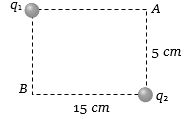
- 5$n$ the rectangle, shown below, the two corners have charges ${q_1} = - 5\,\mu C$ and ${q_2} = + 2.0\,\mu C$. The work done in moving a charge $ + 3.0\,\mu C$ from $B$ to $A$ is.........$J$ $(1/4\pi {\varepsilon _0} = {10^{10}}\,N{\rm{ - }}{m^2}/{C^2})$View Solution
- 6A condenser of $2\,\mu F$ capacitance is charged steadily from $0$ to $5$ $Coulomb$. Which of the following graphs correctly represents the variation of potential difference across its plates with respect to the charge on the condenserView Solution
- 7The radius of nucleus of silver (atomic number $=$ $47$) is $3.4 \times {10^{ - 14}}\,m$. The electric potential on the surface of nucleus is $(e = 1.6 \times {10^{ - 19}}\,C)$View Solution
- 8A parallel plate capacitor with plate area $A$ and plate separation $d =2 \,m$ has a capacitance of $4 \,\mu F$. The new capacitance of the system if half of the space between them is filled with a dielectric material of dielectric constant $K =3$ (as shown in figure) will be .........$ \mu \,F$View Solution
- 9If the capacity of a spherical conductor is $1$ picofarad, then its diameter, would beView Solution
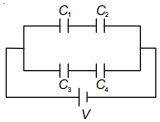
- 10Find the charge on capacitor $C_3$View Solution
Given, that $C_1=C_2=C$ and $C_3=C_4=3 C$.