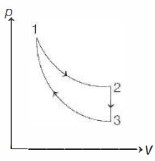
Two moles of monoatomic gas is expanded from $(P_0, V_0)$ to $(P_0 , 2V_0)$ under isobaric condition. Let $\Delta Q_1$, be the heat given to the gas, $\Delta W_1$ the work done by the gas and $\Delta U_1$ the change in internal energy. Now the monoatomic gas is replaced by a diatomic gas. Other conditions remaining the same. The corresponding values in this case are $\Delta Q_2 , \Delta W_2 , \Delta U_2$ respectively, then
Advanced
Download our app for free and get started
since for both cases $P-V$ curve is the same,
$\Delta W_{1}=\Delta W_{2}$ $\Rightarrow \Delta Q_{1}-\Delta U_{1}=\Delta Q_{2}-\Delta U_{2}$
$\Rightarrow \Delta Q_{1}-\Delta Q_{2}=\Delta U_{1}-\Delta U_{2}$
So, option $a$ is correct.
Process is isobaric
Hence $\Delta Q_{1}=n C_{p 1} \Delta T_{1}=\frac{5}{2} n R \Delta T_{1}=\frac{5}{2} P_{0} V_{0}$
Also $\Delta Q_{2}=n C_{P 2} \Delta T_{2}=\frac{7}{2} n R \Delta T_{2}=\frac{7}{2} P_{0} V_{0}$
Hence $\Delta Q_{2}>\Delta Q_{1}$
$\Rightarrow \Delta U_{1}+\Delta W_{1}>\Delta U_{2}+\Delta W_{2}$
So, option $b$ is correct
$\Delta U_{1}=n C_{v 1} \Delta T_{1}=\frac{3}{2} n R \Delta T_{1}=\frac{3}{2} P_{0} V_{0}$
$\Delta U_{2}=n C_{v 2} \Delta T_{2}=\frac{5}{2} n R \Delta T_{2}=\frac{5}{2} P_{0} V_{0}$
Hence $\Delta U_{2}>\Delta U_{1}$
So, option $c$ is also correct

Download our appand get started for free
Experience the future of education. Simply download our apps or reach out to us for more information. Let's shape the future of learning together!No signup needed.*
Similar Questions
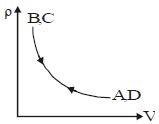
- 1Density $vs$ volume graph is shown in the figure. Find corresponding pressure $vs$ temperature graphView Solution
- 2One mole of an ideal gas at an initial temperature of $T\, K$ does $6 R$ joules of work adiabatically. If the ratio of specific heats of this gas at constant pressure and at constant volume is $5/3$, the final temperature of gas will beView Solution
- 3A total of $48 \mathrm{~J}$ heat is given to one mole of helium kept in a cylinder. The temperature of helium increases by $2^{\circ} \mathrm{C}$. The work done by the gas is : (Given, $\mathrm{R}=8.3 \mathrm{~J} \mathrm{~K}^{-1} \mathrm{~mol}^{-1}$.)View Solution
- 4In a process, temperature and volume of one mole of an ideal monoatomic gas are varied according to the relation $VT = K$, where $I$ is a constant. In this process the temperature of the gas is increased by $\Delta T$. The amount of heat absorbed by gas is ($R$ is gas constant)View Solution
- 5View SolutionIn an isothermal expansion
- 6$Assertion :$ In adiabatic compression, the internal energy and temperature of the system get decreased.View Solution
$Reason :$ The adiabatic compression is a slow process. - 7In changing the state of thermodynamics from $A$ to $B$ state, the heat required is $Q$ and the work done by the system is $W.$ The change in its internal energy isView Solution
- 8Efficiency of Carnot engine is $100\%$ ifView Solution
- 9One mole of an ideal gas at an initial temperature of $T\, K$ does $6\, R\, joules$ of work adiabatically. If the ratio of specific heats of this gas at constant pressure and at constant volume is $\frac{5}{3}$ , the final temperature of gas will beView Solution
- 10The three processes in a thermodynamic cycle shown in the figure are : Process $1 \rightarrow 2$ is isothermal; Process $2 \rightarrow 3$ is isochoric (volume remains constant); Process $3 \rightarrow 1$ is adiabatic. The total work done by the ideal gas in this cycle is $10 \,J$. The internal energy decreases by $20 \,J$ in the isochoric process. The work done by the gas in the adiabatic process is $-20 \,J$. The heat added to the system in the isothermal process is .............. $J$View Solution