MCQ
Efficiency of Carnot engine is $100\%$ if
- A${T_2} = 273\,\,K$
- ✓${T_2} = 0\,\,K$
- C${T_1} = 273\,\,K$
- D${T_1} = 0\,\,K$
Generate a complete, print-ready paper with questions like this in minutes — across 16+ boards, with answer keys.
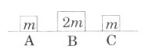
| List-$I$ | List-$II$ |
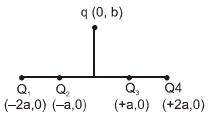
| $P.$ $\quad Q _1, Q _2, Q _3, Q _4$, all positive | $1.\quad$ $+ x$ |
| $Q.$ $\quad Q_1, Q_2$ positive $Q_3, Q_4$ negative | $2.\quad$ $-x$ |
| $R.$ $\quad Q_1, Q_4$ positive $Q_2, Q_3$ negative | $3.\quad$ $+ y$ |
| $S.$ $\quad Q_1, Q_3$ positive $Q_2, Q_4$ negative | $4.\quad$ $-y$ |
| List-$I$ | List-$II$ |
| $P$ $\dot{r}(t)=\alpha t \hat{t}+\beta t \hat{j}$ | $1$ $\overrightarrow{ p }$ |
| $Q$ $\dot{r}(t)=\alpha \cos \omega t \hat{i}+\beta \sin \omega t \hat{j}$ | $2$ $\overrightarrow{ L }$ |
| $R$ $\dot{r}(t)=\alpha(\cos \omega t \hat{i}+\sin \omega t \hat{j})$ | $3$ $K$ |
| $S$ $\dot{r}(t)=\alpha t \hat{i}+\frac{\beta}{2} t^2 \hat{j}$ | $4$ $U$ |
| $5$ $E$ |
| $(a)$ Gravitational constant $(G)$ | $(i)$ $\left[ L ^{2} T ^{-2}\right]$ |
| $(b)$ Gravitational potential energy | $(ii)$ $\left[ M ^{-1} L ^{3} T ^{-2}\right]$ |
| $(c)$ Gravitational potential | $(iii)$ $\left[ LT ^{-2}\right]$ |
| $(d)$ Gravitational intensity | $(iv)$ $\left[ ML ^{2} T ^{-2}\right]$ |
Choose the correct answer from the options given below: