Question
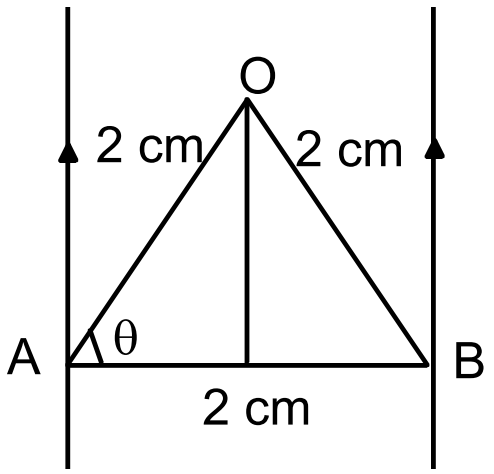
Two parallel wires carry equal currents of 10A along the same direction and are separated by a distance of 2.0cm. Find the magnetic field at a point which is 2.0cm away from each of these wires
Answer


$\cos\theta=\frac{1}{2},$
$\theta=60^\circ\ \&\ \angle\text{AOB}=60^\circ$
$\text{B}=\frac{\mu_0\text{I}}{2\pi\text{r}}=\frac{10^{-7}\times2\times10}{2\times10^{-2}}=10^{-4}\text{T}$
So net is $[(10^{-4})^2]+(10^{-4})^2+2(10^{-8})\cos60^\circ]^\frac{1}{2}$
$=10^{-4}\Big[1+1+2\times\frac{1}{2}\Big]^\frac{1}{2}$
$=10^{-4}\times\sqrt3\text{T}$
$=1.732\times10^{-4}\text{T}$

Need a full question paper?

Generate a complete, print-ready paper with questions like this in minutes — across 16+ boards, with answer keys.
Start Generating Free

Similar questions

In the Bohr model of hydrogen atom, the electron is treated as a particle going in a circle with the centre at the proton. The proton it self is assumed to be fixed in an inertial frame. The centripetal force is provided by the Coloumb attraction. In the ground state, the electron goes round the proton in a circle of radius $5.3 \times 10^{-11}m.$ Find the speed of the electron in the ground state. Mass of the electron $= 9.1 \times 10^{-31}kg$ and charge of the electron $= 1.6 \times 10^{-19}C.$
A straight horizontal wire of mass 10mg and length 1.0m carries a current of 2.0A. What minimum magnetic field B should be applied in the region, so that the magnetic force on the wire may balance its weight?
An electromagnetic wave of wavelength λ is incident on a photosensitive surface of negligible work function. If the photo-electrons emitted from this surface have the de-Broglie wavelength $\lambda_{1}$, prove that $\lambda = \begin{pmatrix} 2 \text{mc} \\ h \end{pmatrix}\lambda^{2}_{1}$.
Why are the magnification properties of microscopes and telescopes defined in terms of the ratio of angles and not in terms of the ratio of sizes of objects and images?
Area of a parallel plate capacitor is A and distance between them is $d$. It is charged with a constant current of I. An element of area $\frac{A}{2}$ is kept in the middle of the plates, parallel to the plates. What is the current flowing through this area?
A toroid has a core $($non$-$ferromagnetic$)$ of inner radius $25 \ cm$ and outer radius $26 \ cm,$ around which $3500$ turns of a wire are wound. If the current in the wire is $11 A,$ what is the magnetic field,
  1. Outside the toroid,
  2. Inside the core of the toroid and,
  3. In the empty space surrounded by the toroid.
$(II) (a)$ Define electric flux and write its $SI$ unit.
$(b)$ Use Gauss᾿s law to obtain the expression for the electric field due to a uniformly charged infinite plane sheet of charge.
The potential difference between the terminals of a battery of emf 6.0V and internal resistance $1\Omega$ drops to 5.8V when connected across an external resistor. Find the resistance of the external resistor.
Calculate the temperature at which the resistance of a conductor becomes 20% more than its resistance at 27°C. The value of the temperature coefficient of resistance of the conductor is $2.0 \times 10\frac{-4}{\text{K}}.$
A string is wrapped on a wheel of moment of inertia $0.20\ kg-m^2$ and radius $10\ cm$ and goes through a light pulley to support a block of mass $2.0\ kg$ as shown in figure. Find the acceleration of the block.