MCQ
Two particles are projected from a tower in opposite directions horizontally with speed $10\,m / s$ each. At $t=1\,s$ match the following two columns.
Column $I$ Column $II$
$(A)$ Relative acceleration between two $(p)$ $0$ SI unit
$(B)$ Relative velocity between two $(q)$ $5$ SI unit
$(C)$ Horizontal distance between two $(r)$ $10$ SI unit
$(D)$ Vertical distance between two $(s)$ $20$ SI unit
  • $( A \rightarrow p , B \rightarrow s , C \rightarrow s , D \rightarrow p )$
  • B
    $( A \rightarrow p , B \rightarrow s , C \rightarrow q , D \rightarrow p )$
  • C
    $( A \rightarrow p , B \rightarrow r , C \rightarrow s , D \rightarrow p )$
  • D
    $( A \rightarrow p , B \rightarrow s , C \rightarrow r , D \rightarrow p )$
Answer

Correct option: A.
$( A \rightarrow p , B \rightarrow s , C \rightarrow s , D \rightarrow p )$
a
(a)

Need a full question paper?

Generate a complete, print-ready paper with questions like this in minutes — across 16+ boards, with answer keys.

Start Generating Free

Similar questions

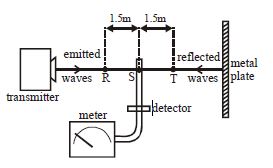
The given diagram shows a detector placed between a transmitter of sound waves and a metal plate. At three adjacent points, $ R, S$ and $T$ , the meter shows zero intensity. Which of the following is the frequency of the emitted wave ... $Hz$ ? (Take the velocity of sound as $ = 300\ m/s$ )
A couple is acting on a two particle systems. The resultant motion will be:
A cyclist is travelling with velocity $v$ on a curved road of radius $R$. The angle $\theta$  through which the cyclist leans inwards is given by
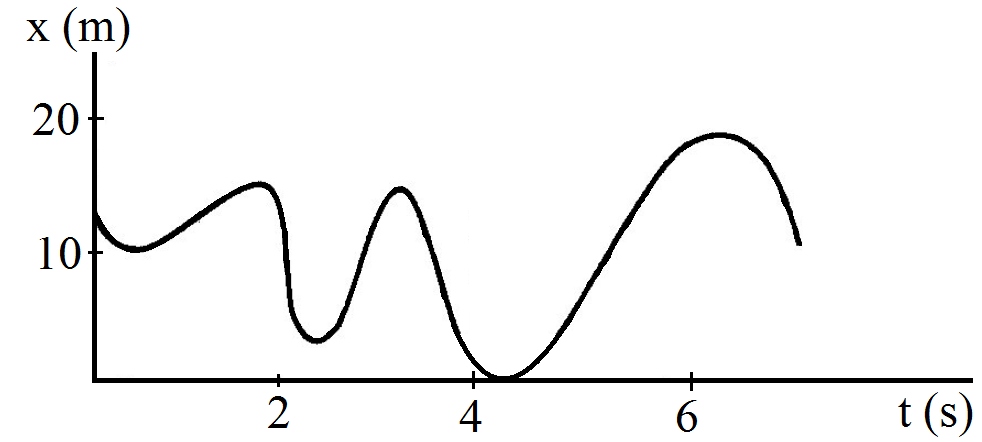
Figure shows the position of a particle moving on the X-axis as a function of time.

The efficiency of Carnot's engine operating between reservoirs, maintained at temperatures ${27^o}C$ and $ - {123^o}C,$ is ...... $\%$
The relationship between pressure and the density of a gas expressed by Boyle’s law, $ P = KD$ holds true
A uniform sphere is placed on a smooth horizontal surface and a horizontal force F is applied on it at a distance h above the surface. The acceleration of the centre:
  1. Is maximum when h = 0.
  2. Is maximum when h = R.
  3. Is maximum when h = 2R.
  4. Is independent of h.
A couple produces
The value of Young's modulus for a perfectly rigid body is ...........
 Three particles start simultaneously from a point on a horizontal smooth plane. First particle moves with speed $v_1$ towards east, second particle moves towards north with speed $v_2$ and third-one moves towards north-east. The velocity of the third particle, so that the three always lie on a line, is