MCQ
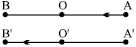
Two particles undergo $SHM$ along parallel lines with the same time period $(T)$ and equal amplitudes. At a particular instant, one particle is at its extreme position while the other is at its mean position. They move in the same direction. They will cross each other after a further time
  • A
    $T/8$
  • $3T/8$
  • C
    $T/6$
  • D
    $4T/3$

Answer

Correct option: B.
$3T/8$
b
The particle which is at mean position. Its $SHM$ can be represented by $x_{1}=-A \sin \omega t$. And the particle which is at extreme position. Its $SHM$ is represented by $x_{2}=A \cos \omega t$ When both cross each other

$x_{1}=x_{2}$

$\Rightarrow-A \sin \omega t=A \cos \omega t$

$\Rightarrow \tan \omega t=-1$

$\Rightarrow \omega t=-\frac{\pi}{4}, \frac{3 \pi}{4}$

$\omega t=-\frac{\pi}{4}$ will give the negative value of time which is not possible.

so

$\omega t=\frac{3 \pi}{4}$

$\Rightarrow \frac{2 \pi}{T} t=\frac{3 \pi}{4}$

$\Rightarrow t=\frac{3 T}{8}$

Need a full question paper?

Generate a complete, print-ready paper with questions like this in minutes — across 16+ boards, with answer keys.

Start Generating Free

Similar questions

Pressure exerted by a gas is found to be $50\, N/m^2$ , then the value of pressure in $CGS$ system is
When an impurity is doped into an intrinsic semiconductor, the conductivity of the semiconductor:
  1. Increases.
  2. Decreases.
  3. Remains the same.
  4. Becomes zero.
A ball falls vertically downward and bounces off a horizontal floor.The speed of the ball just before reaching the floor $\left(u_1\right)$ is equal to the speed just after leaving contact with the floor $\left(u_2\right), u_1=u_2$. The corresponding magnitudes of accelerations are denoted respectively by $a_1$ and $a_2$. The air resistance during motion is proportional to speed and is not negligible. If $g$ is acceleration due to gravity, then
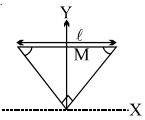
The figure shows an isosceles triangular plate of mass $M$ and base $L$. The angle at the apex is $90^o$. The apex lies at the origin and the base is parallel to $X$ -axis The moment of inertia of the plate about the $z$ -axis is
Put a uniform meter scale horizontally on your extended index fingers with the left one at $0.00 cm$ and the right one at $90.00 cm$. When you attempt to move both the fingers slowly towards the center, initially only the left finger slips with respect to the scale and the right finger does not. After some distance, the left finger stops and the right one starts slipping. Then the right finger stops at a distance $x_R$ from the center ( $50.00 cm$ ) of the scale and the left one starts slipping again. This happens because of the difference in the frictional forces on the two fingers. If the coefficients of static and dynamic friction between the fingers and the scale are $0.40$ and $0.32$ , respectively, the value of $x_R($ in $cm )$ is. . . . . . . 
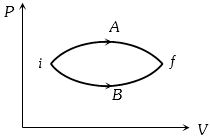
In the figure given two processes $A$ and $B$ are shown by which a thermo-dynamical system goes from initial to final state $F.$ If $\Delta {Q_A}$ and $\Delta {Q_B}$ are respectively the heats supplied to the systems then
$A U-$ tube having horizontal arm of length $20$ $cm$, has uniform cross-sectional area $=1\ cm^2$. It is filled with water of volume $60$ $cc$. What volume of a liquid of density $4$ $g/cc$ should be poured from one side into the $U -$ tube so that no water is left in the horizontal arm of the tube  ........ $cc$ ?
Two springs have their force constant as $k_1$ and $k_2 (k_1 > k_2)$. when they are  stretched by the same force
Two soap bubbles of radii $3r$ and $4r$ in contact with each other. The radius of curvature of the interface between bubbles is
Which of the following functions for $y$ can never represent a travelling wave?

$(a)$ $\left(x^2-v t\right)^2$

$(b)$ $\log \left[\frac{(x+v t)}{x_0}\right]$

$(c)$ $e^{\left\{-\frac{(x+v t)}{x_0}\right\}^2}$

$(d)$ $\frac{1}{x+v t}$