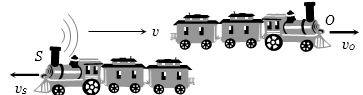
Two passenger trains moving with a speed of $108\, km/hour$ cross each other. One of them blows a whistle whose frequency is $750 Hz.$ If sound speed is $330 m/s,$ then passengers sitting in the other train, after trains cross each other will hear sound whose frequency will be .... $Hz$
Medium
Download our app for free and get started
(b) $n' = n\,\left( {\frac{{v - {v_o}}}{{v + {v_s}}}} \right) = 750\,\left( {\frac{{330 - 180 \times \frac{5}{{18}}}}{{330 + 108 \times \frac{5}{{18}}}}} \right) = 625$$Hz$

Download our appand get started for free
Experience the future of education. Simply download our apps or reach out to us for more information. Let's shape the future of learning together!No signup needed.*
Similar Questions
- 1In stationary waves, distance between a node and its nearest antinode is $20 cm$. The phase difference between two particles having a separation of $60 cm$ will beView Solution
- 2A stone is dropped in a well which is $19.6\,m$ deep. Echo sound is heard after $2.06\, sec$ (after dropping) then the velocity of sound is .... $m/sec$View Solution
- 3A motor car blowing a horn of frequency $124\,vib/sec$ moves with a velocity $72\, km/hr$ towards a tall wall. The frequency of the reflected sound heard by the driver will be .... $vib/sec$ (velocity of sound in air is $330\, m/s$)View Solution
- 4A man can hear sounds in frequency range $120\,Hz$ to $12020\,Hz$. only. He is vibrating a piano string having a tension of $240\,N$ and mass of $3\,gm$ . The string has a length of $8\,m$ . How many different frequencies can he hear ?View Solution
- 5A train moves towards a stationary observer with speed $34\, m/s$. The train sounds a whistle and its frequency registered by the observer is $f_1$. If the speed of the train is reduced to $17\, m/s$, the frequency registered is $f_2$. If speed of sound is $340\, m/s$, then the ratio $f_1/f_2$ isView Solution
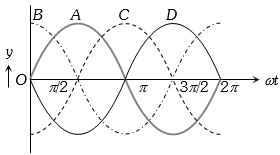
- 6The figure shows four progressive waves $A, B, C$ and $D $ with their phases expressed with respect to the wave $A$. It can be concluded from the figure thatView Solution
- 7Two tuning forks $A\,\, \& \,\,B$ produce notes of frequencies $256 Hz \,\,\& \,\,262 Hz$ respectively. An unknown note sounded at the same time as $A$ produces beats . When the same note is sounded with $B$, beat frequency is twice as large . The unknown frequency could be ... $Hz$View Solution
- 8When a wave travels in a medium, the particle displacement is given by $y\,(x,t) = 0.03\sin \pi (2t - 0.01x)$ where $y$ and $x$ are meters and $t$ in seconds. The phase difference, at a given instant of time between two particle $25 m$. apart in the medium, isView Solution
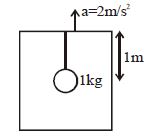
- 9In the figure shown a mass $1\ kg$ is connected to a string of mass per unit length $1.2\ gm/m$ . Length of string is $1\ m$ and its other end is connected to the top of a ceiling which is accelerating up with an acceleration $2\ m/s^2$ . A transverse pulse is produced at the lowest point of string. Time taken by pulse to reach the top of string is .... $s$View Solution
- 10Consider the followingView Solution
$I.$ Waves created on the surfaces of a water pond by a vibrating sources.
$II.$ Wave created by an oscillating electric field in air.
$III.$ Sound waves travelling under water.
Which of these can be polarized