Question
Two pendulums of lengths 100cm and 110.25cm start oscillating in phase simultaneously. After how many oscillations will they again be in phase together?

Answer

$\text{T}=2\pi\sqrt{\frac{\text{l}}{\text{g}}}$$\text{l}_1=100\text{cm}$
$\text{l}_2=110.25\text{cm}$
For smaller pendulum, $\text{T}_1=2\pi\sqrt{\frac{100}{\text{g}}}\cdots\text{(i)}$
For larger pendulum, $\text{T}_2=2\pi\sqrt{\frac{110.25}{\text{g}}}\cdots\text{(ii)}$
Let these pendulums oscillate in phase again if larger pendulum completes 'n' oscillations. It means smaller pendulum must complete (n + 1) oscillations.
$\text{nT}_2=(\text{n}+1)\text{T}_1$
$\frac{\text{n}+1}{\text{n}}$
$\frac{\text{T}_2}{\text{T}_1}=\sqrt{\frac{110.25}{100}}$
$=1.05$
$=1+\frac{1}{\text{n}}$
$=1.05$
$=\frac{1}{\text{n}}=0.05$
$=\frac{5}{100}=\frac{1}{20}$
$\therefore\text{n}=20$
Hence both pendulums will again oscillate in phase after 20 oscillations of the larger or 21 oscillations of the smaller pendulum.

Need a full question paper?

Generate a complete, print-ready paper with questions like this in minutes — across 16+ boards, with answer keys.
Start Generating Free

Similar questions

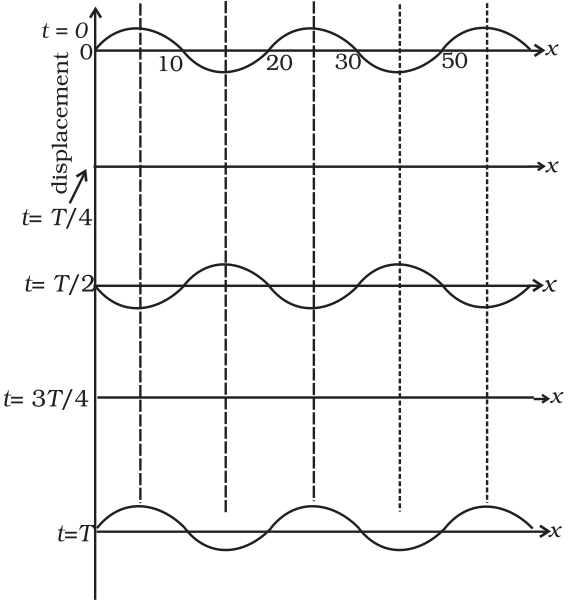
The wave pattern on a stretched string is shown in Interpret what kind of wave this is and find its wavelength.
Explain why?
  1. Inspite of formula $\nu=\sqrt{\frac{\gamma\text{P}}{\rho}},$ the speed of sound in air independent of pressure.
Where $\gamma=$ ratio of specific heats i.e., $\gamma =\frac{\text{C}_\text{p}}{\text{C}_\nu},$ $\rho=$ density, P = pressure.
  1. Bats can ascertain distances, directions, nature and the size of the obstacles without any "eyes”.
A simple pendulum with a brass has a time period T. The bob is now immersed in a non-viscous liquid and oscillated. If the density of the liquid is $\frac{1}{9}$ that of brass, find the time period of the same pendulum.
The magnetic field B and the magnetic intensity H in material are found to be 1.6T and 1000A/m reepectively. Calculate the relative permeability $\mu_\text{r}$ and the susceptibility x of the material.
A threaded rod with 12turns/ cm and diameter 1.18cm is mounted horizontally. A bar with a threaded hole to match the rod is screwed onto the rod. The bar spins at 216rev/ min. How long will it take for the bar to move 1.50cm along the rod?
India has had a long and unbroken tradition of great scholarship-in mathematics, astronomy, linguistics, logic and ethics. Yet, in parallel with this, several superstitious and obscurantistic attitudes and practices flourished in our society and unfortunately continue even today-among many educated people too. How will you use your knowledge of science to develop strategies to counter these attitudes?
A projectile is projected horizontally with a velocity u. Show that its trajectory is parabolic. And obtain expressions for:
i. Time of flight
ii. Horizontal range
iii. Velocity at any instant $t$.
Draw a graph to show the variation of P.E., K.E. and total energy of a simple harmonic oscillator with displacement.
The motion of a particle executing simple harmonic motion is described by the displacement function,$\text{x(t)}=\text{A}\cos(\omega\text{t}+\phi).$
If the initial (t = 0) position of the particle is 1cm and its initial velocity is $\omega\text{ cm/s,}$ what are its amplitude and initial phase angle? The angular frequency of the particle is $\pi\text{s}^{-1}.$ If instead of the cosine function, we choose the sine function to describe the SHM: $\text{x}=\text{B}\sin(\omega\text{t}+\alpha),$ what are the amplitude and initial phase of the particle with the above initial conditions.
A particle slides on the surface of a fixed smooth sphere starting from the topmost point. Find the angle rotated by the radius through the particle, when it leaves contact with the sphere.