MCQ
Two pieces of glass plate one upon the other with a little water in between them cannot be separated easily because of
  • A
    Inertia
  • B
    Pressure
  • Surface tension
  • D
    Viscosity

Answer

Correct option: C.
Surface tension
c
(c)Surface tension pulls the plates towards each other.

Need a full question paper?

Generate a complete, print-ready paper with questions like this in minutes — across 16+ boards, with answer keys.

Start Generating Free

Similar questions

A stone thrown down with a speed $u$ takes a time $t_1$ to reach the ground, while another stone thrown upwards from the same point with the same speed takes time $t_2$. The maximum height the second stone reaches from the ground is
$A$ block of mass $M$ is placed on $a$ horizontal surface and it is tied with an inextensible string to $a$ block of mass, as shown in figure. A block of mass $m_0$ is also placed on $M$ The minimum value of $\mu$ between the block $M$ and $m_0$ (taking horizontal surface frictionless) for which all the three blocks move together, is
The difference between the apparent frequency of a source of sound as perceived by an observer during its approach and recession is $2\%$ of the natural frequency of the source. If the velocity of sound in air is $300 \,m/sec,$ the velocity of the source is ... $m/sec$ (It is given that velocity of source $<<$ velocity of sound)
A photon of energy hv is absorbed by o free electron of a metal having work function $\varphi<\text{hv}.$
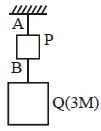
Wires $A$ and $B$ are connected with blocks $P$ and $Q$ as shown. The ratio of lengths, radii and Young's modulus of wires $A$ and $B$ are $r, 2r$ and $3r$ respectively ($r$ is a constant). Find the mass of block $P$ if ratio of increase in their corresponding lengths is $1/6r^2$. The mass of block $Q$ is $3M$.
If Poission's ratio $\sigma $ is $ - \frac{1}{2}$ for a material, then the material is
A body of mass $2 \ kg$ travels according to the law $\mathrm{x}(\mathrm{t})=\mathrm{pt}+\mathrm{qt}^2 \mathrm{rt}^3$ where $\mathrm{p}=3 \mathrm{~m} \mathrm{~s}^{-1}, \mathrm{q}=4 \mathrm{~m} \mathrm{~s}^{-2}$ and $\mathrm{r}=5 \mathrm{~m} \mathrm{~s}^{-3}$. The force acting on the body at $t=2$ seconds is.
Two copper vessels $A$ and $B$ have the same base area but of different shapes. $A$ takes twice the volume of water as that $B$ requires to fill upto a particular common height. Then the correct statement among the following is
A stone is projected from ground at $t = 0$. At the time of projection horizontal and vertical component of velocity are $10\, m/s$ and $20\, m/s$ respectively. Then time at which tangential and normal acceleration magnitude will be equal $(g = 10\, m/s^2)$ [neglect air friction]    ......... $\sec$
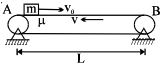
With what minimum velocity should block be projected from left end $A$ towards end $B$ such that it reaches the other end $B$ of conveyer belt moving with constant velocity $v$. Friction coefficient between block and belt is $\mu$ .