MCQ
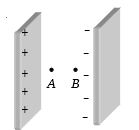
Two protons $A$ and $B$ are placed in space between plates of a parallel plate capacitor charged upto $V$ volts (See fig.) Forces on protons are ${F_A}$ and ${F_B}$, then
  • A
    ${F_A} > {F_B}$
  • B
    ${F_A} < {F_B}$
  • ${F_A} = {F_B}$
  • D
    Nothing can be said

Answer

Correct option: C.
${F_A} = {F_B}$
c
(c) ${F_A} = {F_B}$; because an uniform electric field produced between the plates.

Need a full question paper?

Generate a complete, print-ready paper with questions like this in minutes — across 16+ boards, with answer keys.

Start Generating Free

Similar questions

Which one of the following devices makes use of the electrons to strike certain substances to produce fluorescence
Voltage rating of a parallel plate capacitor is $500\,V$. Its dielectric can withstand a maximum electric field of ${10^6}\,\frac{V}{m}$. The plate area is $10^{-4}\, m^2$ . What is the dielectric constant if the capacitance is $15\, pF$ ? (given ${ \in _0} = 8.86 \times {10^{ - 12}}\,{C^2}\,/N{m^2}$)
The cathode of a photoelectric cell is changed such that the work function changes from $W_1$ to $W_2\left(W_2>W_1\right)$. If the current before and after change are $\mathrm{I}_1$ and $\mathrm{I}_2$, all other conditions remaining unchanged, then (assuming $\mathrm{hn}>\mathrm{W}_2$ )
How much energy in kilowatt hour is consumed in operating ten 50 watt bulbs for 10 hours per day in a month (30 days).
Two point charges $+8q$ and $ - 2q$ are located at $x = 0$ and $x = L$ respectively. The location of a point on the $x$-axis at which the net electric field due to these two point charges is zero is
Consider telecommunication through optical fibres. Which of the following statements is not true
Let $R _1$ be the radius of the second stationary orbit and $R_2$ be the radius of the fourth stationary orbit of an electron in Bohr's model. The ratio $\frac{ R _1}{ R _2}$ is
Let there be a spherically symmetric charge distribution with charge density varying as $\text{p}(\text{r})=\text{p}_0\bigg(\frac{5}{4}-\frac{\text{r}}{\text{R}}\bigg)$ upto $r = R$ and $p(r) = 0$ for $r > R$ where $r$ is the distance from the origin the electric field at a distance $r(r < R)$ from the origin is given by.
Find equivalent resistance between $A$ and $B$
The electron emitted in beta radiation originates from