Young's moduli of the material of wires $A$ and $B$ are in the ratio of $1: 4$, while its area of cross sections are in the ratio of $1: 3$. If the same amount of load is applied to both the wires, the amount of elongation produced in the wires $A$ and $B$ will be in the ratio of
[Assume length of wires $A$ and $B$ are same]
JEE MAIN 2023, Medium


Download our appand get started for free
Experience the future of education. Simply download our apps or reach out to us for more information. Let's shape the future of learning together!No signup needed.*
Similar Questions
- 1View SolutionWhich of the following statements is correct
- 2A wire of length $2\, m$ is made from $10\;c{m^3}$ of copper. A force $F$ is applied so that its length increases by $2\, mm.$ Another wire of length 8 m is made from the same volume of copper. If the force $F$ is applied to it, its length will increase by......... $cm$View Solution
- 3The Young's modulus of a rubber string $8\, cm$ long and density $1.5\,kg/{m^3}$ is $5 \times {10^8}\,N/{m^2}$, is suspended on the ceiling in a room. The increase in length due to its own weight will beView Solution
- 4Force constant of a spring $(K)$ is synonymous toView Solution
- 5View SolutionThe Poisson's ratio cannot have the value
- 6If $x$ longitudinal strain is produced in a wire of Young's modulus $y,$ then energy stored in the material of the wire per unit volume isView Solution
- 7The length of an elastic string is a metre when the longitudinal tension is $4\, N$ and $b$ metre when the longitudinal tension is $5\, N$. The length of the string in metre when the longitudinal tension is $9\, N$ isView Solution
- 8View SolutionFour identical rods are stretched by same force. Maximum extension is produced in
- 9Copper of fixed volume $V$ is drawn into wire of length $l$. When this wire is subjected to a constant force $F$, the extension produced in the wire is $\Delta l$. Which of the following graphs is a straight line?View Solution
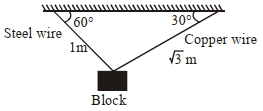
- 10A block of weight $100 N$ is suspended by copper and steel wires of same cross sectional area $0.5 cm ^2$ and, length $\sqrt{3} m$ and $1 m$, respectively. Their other ends are fixed on a ceiling as shown in figure. The angles subtended by copper and steel wires with ceiling are $30^{\circ}$ and $60^{\circ}$, respectively. If elongation in copper wire is $\left(\Delta \ell_{ C }\right)$ and elongation in steel wire is $\left(\Delta \ell_{ s }\right)$, then the ratio $\frac{\Delta \ell_{ C }}{\Delta \ell_{ S }}$ is. . . . . .View Solution
[Young's modulus for copper and steel are $1 \times 10^{11} N / m ^2$ and $2 \times 10^{11} N / m ^2$ respectively]