MCQ
Two sound waves having a phase difference of $60^{\circ}$ have path difference of
  • A
    $2 \lambda$
  • B
    $\lambda / 2$
  • $\lambda / 6$
  • D
    $\lambda / 3$

Answer

Correct option: C.
$\lambda / 6$
(c) Path difference $\Delta=\frac{\lambda}{2 \pi} \times \phi=\frac{\lambda}{2 \pi} \times \frac{\pi}{3}=\frac{\lambda}{6}$

Need a full question paper?

Generate a complete, print-ready paper with questions like this in minutes — across 16+ boards, with answer keys.
Start Generating Free

Similar questions

Find the change in internal energy of the system when a system absorbs $2$ kilocalorie of heat and at the same time does $500$ joule of work
$80 \mathrm{gm}$ of water at $30^{\circ} \mathrm{C}$ are poured on a large block of ice at $0^{\circ} \mathrm{C}$. The mass of ice that melts is
At ordinary temperatures, the electrical conductivity of semi conductors in mho/meter is in the range
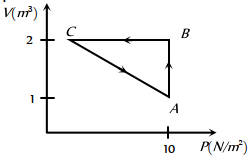
An ideal gas is taken through the cycle $A \rightarrow B \rightarrow C \rightarrow A$, as shown in the figure. If the net heat supplied to the gas in the cycle is $5 \mathrm{~J}$, the work done by the gas in the process $C \rightarrow A$ is
Pick out the longest wavelength from the following types of radiations
$P$-type semiconductors are made by adding impurity element
The mass of two substances are $4 \mathrm{gm}$ and $9 \mathrm{gm}$ respectively. If their kinetic energies are same, then the ratio of their momenta will be
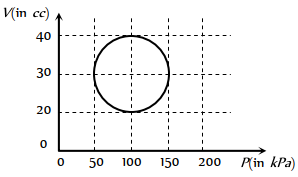
A system is taken through a cyclic process represented by a circle as shown. The heat absorbed by the system isImage
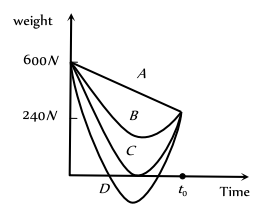
Suppose, the acceleration due to gravity at the earth's surface is 10 $\mathrm{m} / \mathrm{s}$ and at the surface of Mars it is $4.0 \mathrm{~m} / \mathrm{s}$. A $60 \mathrm{~kg}$ passenger goes from the earth to the Mars in a spaceship moving with a constant velocity. Neglect all other objects in the sky. Which part of figure best represents the weight (net gravitational force)of the passenger as a function of time.

Image

A small disc is on the top of a hemisphere of radius $R$. What is the smallest horizontal velocity $v$ that should be given to the disc for it to leave the hemisphere and not slide down it ? $[$There is no friction$]$