Question
Two statements are given-one labelled Assertion(A) and the other labelled Reason (R). Select the correct answer to these questions from the codes(a), (b), (c) and (d) as given below.
  1. Both A and R are true and R is the correct explanation of A.
  2. Both A and R are true but R is NOT the correct explanation of A.
  3. A is true but R is false.
  4. A is false and R is also false.
Assertion (A): The true geographic north direction is found by using a compass needle.
Reason (R): The magnetic meridian of the earth is along the axis of rotation of the earth.
Answer

  1. A is false and R is also false.
Explanation:
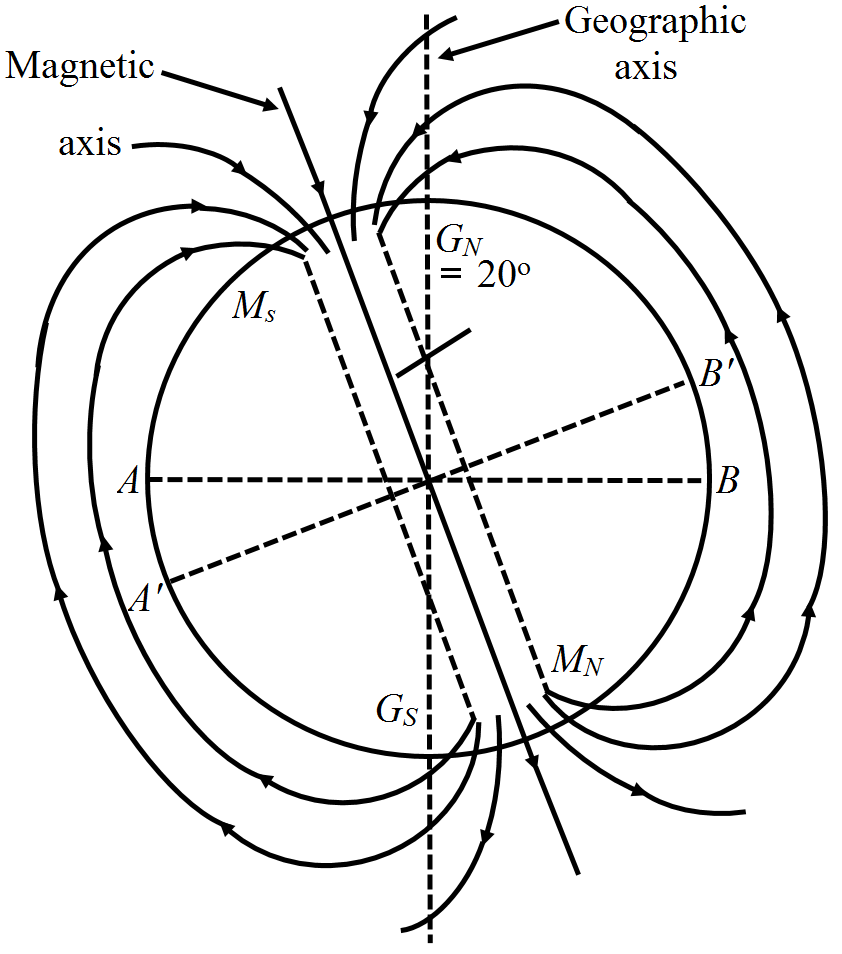
From the compass we are able to know the poles.the north of compass points towards the magnetic south pole.

If we know the magnetic declination at that particular place (which is angle between geographic meridian and magnetic meridian) we can easily find out the true geographic north-south direction. Imaginary lines drawn along the earth's surface in the direction of the horizontal component of the magnetic field of the earth at all points passing through the north and south magnetic poles. This is similar to the longitudes of the earth, which pass through the geographic north and south poles.
 

Need a full question paper?

Generate a complete, print-ready paper with questions like this in minutes — across 16+ boards, with answer keys.

Start Generating Free

Similar questions

For question two statements are given-one labelled Assertion (A) and the other labelled Reason (R). Select the correct answer to these questions from the codes (a), (b), (c) and (d) as given below.
  1. Both A and R are true, and R is the correct explanation of A.
  2. Both A and R are true, but R is NOT the correct explanation of A.
  3. A is true, but R is false.
  4. A is false and R is also false.
Assertion (A): The force of repulsion between atomic nucleus and $\alpha$-particle varies with distance according to inverse square law.
Reason (R): Rutherford did $\alpha$-particle scattering experiment.
For two statements are given$-$one labelled Assertion $(A)$ and the other labelled Reason $(R)$.
Select the correct answer to these questions from the codes $(a), (b), (c)$ and $(d)$ as given below.
Assertion: At resonance$, \text{LCR}$ series circuit have a maximum current.
Reason: At resonance, in $\text{LCR}$ series circuit, the current and $e.m.f$ are in phase with each other.
Assertion: Positive charge always moves from a higher potential point to a lower potential point.
Reason: Electric potential is a vector quantity.
For two statements are given-one labelled Assertion (A) and the other labelled Reason (R). Select the correct answer to these questions from the codes (a), (b), (c) and (d) as given below.
  1. Both A and R are true, and R is the correct explanation of A.
  2. Both A and R are true, but R is not the correct explanation of A.
  3. A is true, but R is false.
  4. A is false, and R is also false.
Assertion (A): An applied electric field will polarize the polar dielectric material.
Reason (R): In polar dielectrics, each molecule has a permanent dipole moment but these are randomly oriented in the absence of an externally applied electric field.
For two statements are given-one labelled Assertion (A) and the other labelled Reason (R). Select the correct answer to these questions from the codes (a), (b), (c) and (d) as given below.
  1. Both A and R are true, and R is the correct explanation of A.
  2. Both A and R are true, but R is not the correct explanation of A.
  3. A is true but R is false.
  4. A is false and R is also false.
Assertion (A): A point charge is brought in an electric field. The field at a nearby point is increase, whatever be the nature of the charge.
Reason (R): The electric field is independent of the nature of charge.
For question two statements are given-one labelled Assertion (A) and the other labelled Reason (R). Select the correct answer to these questions from the codes (a), (b), (c) and (d) as given below.
  1. Both A and R are true, and R is the correct explanation of A.
  2. Both A and R are true, but R is NOT the correct explanation of A.
  3. A is true, but R is false.
  4. A is false and R is also false.
Assertion (A): Smoky flame of Bunsen burner gives continuous spectrum whereas its blue flame gives band spectrum.
Reason (R): The band spectrum consists of coloured bands of light on a dark background.
Two statements are given-one labelled Assertion (A) and the other labelled Reason (R). Select the correct answer to these questions from the codes (a), (b), (c) and (d) as given below.
  1. Both A and R are true and R is the correct explanation of A.
  2. Both A and R are true but R is not the correct explanation of A.
  3. A is true but R is false.
  4. A is false and R is also false.
Assertion: Optical fibers are used to transmit light without any loss in its intensity over distance of several kilometers.
Reason: Optical fibers are very thick and all the light is passed through it without any loss.
Assertion (A) :A step-up transformer cannot be used as a step-down transformer.
Reason (R): A transformer works only in one direction.
For question two statements are given-one labelled Assertion (A) and the other labelled Reason (R). Select the correct answer to these questions front the codes (a), (b), (c) and (d) as given below.
  1. Both A and R are true and R is the correct explanation of A.
  2. Both A and R are true but R is NOT the correct explanation of A.
  3. A is true but R is false.
  4. A is false and R is also false.
Assertion (A): The de-Broglie wavelength of a neutron when its kinetic energy is K is $\lambda$. Its wavelength is $2\lambda$, when its kinetic energy is 4K.
Reason (R): The de-Broglie wavelength $\lambda$ is directly proportional to square root of the kinetic energy.
For two statements are given$-$one labelled Assertion $(A)$ and the other labelled Reason $(R).$ Select the correct answer to these questions from the codes $(a), (b), (c)$ and $(d)$ as given below.
  1. Both $A$ and $R$ are true, and $R$ is the correct explanation of $A.$
  2. Both $A$ and $R$ are true, but $R$ is not the correct explanation of $A.$
  3. $A$ is true but $R$ is false.
  4. $A$ is false and $R$ is also false.
Assertion $(A):$ The electric tines of forces diverges from a positive charge and converge at a negative charge.
Reason $(A): A$ charged particle free to move in an electric field always move along an electric line of force.