Question
Two students Ankit and Vinod appeared in an examination. The probability that Ankit will qualify the examination is $0.05$ and that Vinod will qualify is $0.10.$ The probability that both will qualify is $0.02.$
$i.$ Find the probability that atleast one of them will qualify the exam. $(1)$
$ii.$ Find the probability that atleast one of them will not qualify the exam. $(1)$
$iii.$ Find the probability that both Ankit and Vinod will not qualify the exam. $(2)$
OR
Find the probability that only one of them will qualify the exam. $(2)$
Answer

$i.$ Let $E_1$ and $E_2$ denotes the events that Ankit and Vinod will respectively qualify the exam.
$P\left(E_1 \cup E_2\right)= P \left( E _1\right)+ P \left( E _2\right)- P \left( E _1 \cap E _2\right)$
$=0.05+0.10-0.02=0.13$
$iii.$ Let $E_1$ and $E_2$ denotes the events that Ankit and Vinod will respectively qualify the exam.
$=P\left(E_1^{\prime} \cap E_2^{\prime}\right)=P\left(\left(E_1 \cup E_2\right)^{\prime}\right)$
$=1- P \left(E_1 \cup E_2\right)=1-0.13=0.87$
OR
Let $E_1$ and $E_2$ denotes the events that Ankit and Vinod will respectively qualify the exam.
The probability that Vinod will not qualify the exam. 
Probability that only one of them will qualify the exam $= P \left(\left( E _1- E _2\right) \cup\left( E _2- E _1\right)\right)$
$=P\left(E_1-E_2\right)+P\left(E_2-E_1\right)$
$=P\left(E_1 \cup E_2\right)-P\left(E_1 \cap E_2\right)$
$=0.13-0.02=0.11$

Need a full question paper?

Generate a complete, print-ready paper with questions like this in minutes — across 16+ boards, with answer keys.

Start Generating Free

Similar questions

The school organised a cultural event for $100$ students. In the event, $15$ students participated in dance, drama and singing. $25$ students participated in dance and drama; $20$ students participated in drama and singing; $30$ students participated in dance and singing. $8$ students participated in dance only; $5$ students in drama only and $12$ students in singing only.

Based on the above information, answer the following questions.
  1. The number of students who participated in dance, is:
  1. $18$
  2. $30$
  3. $40$
  4. $48$
  1. The number of students who participated in drama, is:
  1. $35$
  2. $30$
  3. $25$
  4. $20$
  1. The number of students who participated in singing, is:
  1. $42$
  2. $45$
  3. $47$
  4. $37$
  1. The number of students who participated in dance and drama but not in singing, is:
  1. $20$
  2. $5$
  3. $10$
  4. $15$
  1. The number of students who did not participate in any of the events, is:
  1. $20$
  2. $30$
  3. $25$
  4. $35$
For a group of $200 $ candidates, the mean and the standard deviation of scores were found to be $40$ and $15 ,$ respectively. Later on it was discovered that the scores of $43$ and $35$ were misread as $34$ and $53,$ respectively.
Student English Hindi S.st Science Maths
Ramu $39$ $59$ $84$ $80$ $41$
Rajitha $79$ $92$ $68$ $38$ $75$
Komala $41$ $60$ $38$ $71$ $82$
Patil $77$ $77$ $87$ $75$ $42$
Pursi $72$ $65$ $69$ $83$ $67$
Gayathri $46$ $96$ $53$ $71$ $39$
$i.$ Find the correct variance. $(1)$
$ii$. What is the formula of variance. $(1)$
$iii.$  Find the correct mean. $(2)$​​​​​​​
OR
Find the sum of correct scores.$ (2)$
Five students Ajay, Shyam, Yojana, Rahul and Akansha are sitting in a playground in a line.
Image
Based on the above information, answer the following questions.

(i) Total number of ways of sitting arrangement of five students is
    (a) 120     (b) 60     (c) 24     (d) None of these

(ii) Total number of arrangement of sitting, if Ajay and Yojana sit together, is
    (a) 60     (b) 48     (c) 72     (d) 120

(iii) Total number of arrangement 'Yojana and Rahul sitting at extreme position' is
    (a) 24     (b) 36     (c) 48     (d) 12

(iv) Total number of arrangement, if shyam is sitting in the middle, is
    (a) 24     (b) 12     (c) 6     (d) 36

(v) Total number of arrangement sitting Yojana and Rahul not sit together, is
    (a) 72     (b) 120     (c) 60     (d) 144
In a class test of class XI, a teacher asked to students to consider $\mathbf{A}+\mathbf{B}=\frac{\pi}{4}$, where $\mathbf{A}$ and $\mathbf{B}$ are acute angles.
Based on the above information, answer the following questions.
(i) Find the value of $(1+\tan A)(1+\tan B)$ ?
(ii) Find the value of $(\cot \mathbf{A}-1)(\cot \mathbf{B}-1)$ ?
(iii) Find the value of
$
\sin (A+B)-\cos (A+B)+\tan (A+B) .
$
Two complex numbers $Z _1= a + ib$ and $Z _2= c + id$ are said to be equal, if $a = c$ and $b = d$.
$i.$ If $(x+i y)(2-3 i)=4+i$ then find the value of $(x, y)$.
$ii.$ If $\frac{(1+i)^2}{2-i}=x+i y$, then find the value of $x+y. (1)$
$iii.$ If $\left(\frac{1-i}{1+i}\right)^{100}=a+i b$, then find the values of $a$ and $b. (2)$
$OR$
If $(a-2,2 b+1)=(b-1, a+2)$, then find the real values of $a$ and $b. (2)$
In a library, $25$ students read physics, chemistry and mathematics books. It was found that $15$ students read mathematics, $12$ students read physics while $11$ students read chemistry. $5$ students read both mathematics and chemistry, $9$ students read physics and mathematics. $4$ students read physics and chemistry and $3$ students read all three subject books.

Based on the above information, answer the following questions.
  1. The number of students who reading only chemistry is:
  1. $5$
  2. $4$
  3. $2$
  4. $1$
  1. The number of students who reading only mathematics is:
  1. $4$
  2. $3$
  3. $5$
  4. $11$
  1. The number of students who reading only one of the subjects is:
  1. $5$
  2. $11$
  3. $8$
  4. $6$
  1. The number of students who reading atleast one of the subject is:
  1. $20$
  2. $22$
  3. $23$
  4. $21$
  1. The number of students who reading none of the subject is:
  1. $2$
  2. $4$
  3. $3$
  4. $5$
Ashish is writing examination. He is reading question paper during reading time. He reads instructions carefully. While reading instructions, he observed that the question paper consists of $15$ questions divided in to two parts part $I$ containing $8$ questions and part $II$ containing $7$ questions.
Image

$i$. If Ashish is required to attempt $8$ questions in all selecting at least $3$ from each part, then in how many ways can he select these questions $(1)$
$ii$. If Ashish is required to attempt $8$ questions in all selecting $3$ from $I$ part, then in how many ways can he select these questions $(1)$
$iii.$ If Ashish is required to attempt $8$ questions in all selecting $4$ from part $I$ and $4$ from part $II,$ then in how many ways can he select these questions $(2)$
OR
If Ashish is required to attempt $8$ questions in all selecting $6$ from one section and remaining from another section, then in how many ways can he select these questions $(2)$
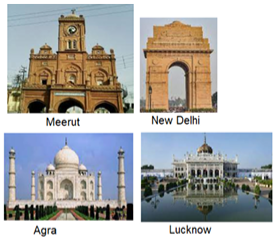
On her vacation, Priyanka visits four cities. Delhi, Lucknow, Agra, Meerut in a random order.
Image

$i$. What is the probability that she visits Delhi before Lucknow? $(1)$
$ii$. What is the probability she visit Delhi before Lucknow and Lucknow before Agra? $(1)$
$iii.$ What is the probability she visits Delhi first and Lucknow last? $(2)$
OR
What is the probability she visits Delhi either first or second? $(2)$