MCQ
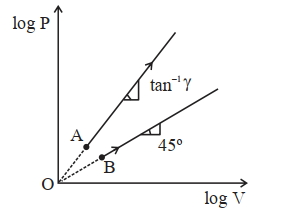
Two thermodynamical process are shown in the figure. The molar heat capacity for process $A$ and $B$ are $C_A$ and $C_B$. The molar heat capacity at constant pressure and constant volume are represented by $C_P$ and $C_V$, respectively. Choose the correct statement.
  • A
     $C_B=\infty, C_A=0$
  • B
     $C_A=0$ and $C_B=\infty$
  • $C_P>C_B>C_A>C_v$
  • D
     $C_A>C_P>C_V$

Answer

Correct option: C.
$C_P>C_B>C_A>C_v$
c
For process $\mathrm{A}$

$ \log P=\gamma \log \mathrm{V} \Rightarrow \mathrm{P}=\mathrm{V}^\gamma,(\gamma>1) $

$ P V^{-\gamma}=\text { Constant } $

$ C_A=C_V+\frac{R}{1+\gamma} \ldots . \text { (i) }$

Likewise for process $\mathrm{B} \rightarrow P V^{-1}=$ $Cons$ $\tan t$

$C_B$ $ =C_v+\frac{R}{1+1} $

$C_B$ $ =C_v+\frac{R}{2} $ $.............(ii)$

$C_P$ $=C_v+R$       $...........(iii)$

By $(i)$, $(ii)$ & $(iii)$ $C_P>C_B>C_A>C_v$ [No answer matching]

Need a full question paper?

Generate a complete, print-ready paper with questions like this in minutes — across 16+ boards, with answer keys.

Start Generating Free

Similar questions

The average density of Earth’s crust $10\ km$ beneath the surface is $2.7\ gm/cm^3$ . The speed of longitudinal seismic waves at that depth is $5.4\ km/s$ . The bulk modulus of Earth’s crust considering its behaviour as fluid at that depth is
The adjoining figure shows the $P-V$ diagram for a fixed mass of an ideal gas undergoing cyclic process. $AB$ represents isothermal process and $CA$ represents isochoric process.Which of the graph shown in the following figures represents the $P-T$ diagram of the cyclic process ?
Surface of the lake is at $2^{\circ} C$. The temperature of the bottom of the lake is ....... $^{\circ} C$
For the system shown in figure, the pulleys are light and frictionless. The tension in the string will be
Relation between emissivity $e$ and absorptive power $a$ is (for black body)
Two communicating vessels contain mercury. The diameter of one vessel is $n$ times larger than the diameter of the other. A column of water of height $ h$  is poured into the left vessel. The mercury level will rise in the right-hand vessel ($s =$ relative density of mercury and $\rho  = $ density of water) by
In figure, two blocks $M$ and $m$ are tied together with an inextensible and light string. The mass $M$ is placed on a rough horizontal surface with coefficient of friction $\mu$ and the mass $m$ is hanging vertically against a smooth vertical wall. The pulley is frictionless. When the downward acceleration of the elevator becomes equal to $g$, then
Which of the following are true?
  1. A polar satellite goes around the earth’s pole in northsouth direction.
  2. A geostationary satellite goes around the earth in eastwest direction.
  3. A geostationary satellite goes around the earth in westeast direction.
  4. A polar satellite goes around the earth in eastwest direction.
The work done to raise a mass $\mathrm{m}$ from the surface of the earth to a height $\mathrm{h}$, which is equal to the radius of the earth, is 
If the current in the circuit for heating the filament is increased, the cutoff wavelength: