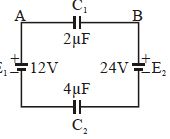
Calculate the amount of charge on capacitor of $4\, \mu\, {F}$. The internal resistance of battery is $1\, \Omega$ : (in $\mu {C}$)
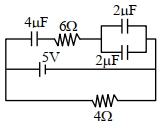
JEE MAIN 2021, Diffcult

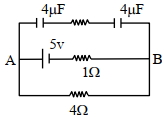

Download our appand get started for free
Experience the future of education. Simply download our apps or reach out to us for more information. Let's shape the future of learning together!No signup needed.*
Similar Questions
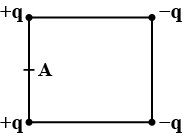
- 1Four electric charges $+q,+q, -q$ and $-q$ are placed at the comers of a square of side $2L$ (see figure). The electric potential at point $A,$ midway between the two charges $+q$ and $+q,$ isView Solution
- 2Two metal spheres of capacitance ${C_1}$ and ${C_2}$ carry some charges. They are put in contact and then separated. The final charges ${Q_1}$ and ${Q_2}$ on them will satisfyView Solution
- 3A $10\,\mu F$ capacitor is charged to a potential difference of $1000\, V$. The terminals of the charged capacitor are disconnected from the power supply and connected to the terminals of an uncharged $6\, \mu F$ capacitor. What is the final potential difference across each capacitor?......$V$View Solution
- 4The electrostatic potential inside a charged spherical ball is given by : $V = b -ar^2$, where $r$ is the distance from the centre ; $a$ and $b$ are constants. Then, the charge density inside the ball is :View Solution
- 5Three particles, each having a charge of $10\,\mu C$ are placed at the corners of an equilateral triangle of side $10\,cm$. The electrostatic potential energy of the system is.....$J$ (Given $\frac{1}{{4\pi {\varepsilon _0}}} = 9 \times {10^9}\,N - {m^2}/{C^2}$)View Solution
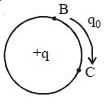
- 6A circle of radius $R$ is drawn with charge $+ q$ at the centre. A charge $q_0$ is brought from point $B$ to $C$, then work done isView Solution
- 7A dielectric slab of thickness $d$ is inserted in a parallel plate capacitor whose negative plate is at $x = 0$ and positive plate is at $x = 3d$. The slab is equidistant from the plates. The capacitor is given some charge. As one goes from $0$ to $3d$View Solution
- 8Two capacitors $C_1$ and $C_2$ are connected in a cirucit as shown in figure. The potential difference $(V_A -V_B)$ is.....$V$View Solution
- 9Equipotential surfaces associated with an electric field which is increasing in magnitude along the $x$-direction areView Solution
- 10Three capacitors each of $4\,\,\mu F$ are to be connected in such a way that the effective capacitance is $6\,\,\mu F.$ This can be done by connecting thernView Solution