Two toroids $1$ and $2$ have total number of tums $200$ and $100 $ respectively with average radii $40\; \mathrm{cm}$ and $20 \;\mathrm{cm}$ respectively. If they carry same current $i,$ the ratio of the magnetic flelds along the two loops is
NEET 2019, Medium
Download our app for free and get started
$\mathrm{B}=\frac{\mu_{0} \mathrm{N}_{\mathrm{i}}}{2 \pi \mathrm{r}}$
$\frac{\mathrm{B}_{1}}{\mathrm{B}_{2}}=\frac{\mathrm{N}_{1}}{\mathrm{N}_{2}} \frac{\mathrm{r}_{2}}{\mathrm{r}_{1}}=\left(\frac{200}{100}\right)\left(\frac{20}{40}\right)=1: 1$

Download our appand get started for free
Experience the future of education. Simply download our apps or reach out to us for more information. Let's shape the future of learning together!No signup needed.*
Similar Questions
- 1Three long straight wires are connected parallel to each other across a battery of negligible internal resistance. The ratio of their resistances are $3 : 4 : 5$. What is the ratio of distances of middle wire from the others if the net force experienced by it is zeroView Solution
- 2View SolutionOne Tesla is equal to
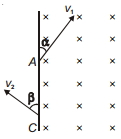
- 3A particle of charge $-q$ and mass $m$ enters a uniform magnetic field $\vec{B}$ at $A$ with speed $v_1$ at an angle $\alpha$ and leaves the field at $C$ with speed $v_2$ at an angle $\beta$ as shown. ThenView Solution
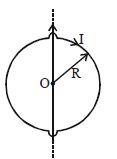
- 4A circular conducting loop of radius $R$ carries a current $I.$ Another straight infinite conductor carrying current $I$ passes through the diameter of this loop as shown in the figure. The magnitude of force exerted by the straight conductor on the loop isView Solution
- 5To convert a $800\, mV$ range milli voltmeter of resistance $40 \,\Omega$ into a galvanometer of $100\, mA$ range, the resistance to be connected as shunt is .............. $\Omega $View Solution
- 6A wire of length $L$ metre carrying a current of $I$ ampere is bent in the form of circle. Its magnetic moment isView Solution
- 7Two parallel wires in the plane of the paper are distance $X _0$ apart. A point charge is moving with speed $u$ between the wires in the same plane at a distance $X_1$ from one of the wires. When the wires carry current of magnitude $I$ in the same direction, the radius of curvature of the path of the point charge is $R_1$. In contrast, if the currents $I$ in the two wires have direction opposite to each other, the radius of curvature of the path is $R_2$.View Solution
If $\frac{x_0}{x_1}=3$, the value of $\frac{R_1}{R_2}$ is.
- 8The relation between voltage sensitivity (${\sigma _V}$) and current sensitivity $({\sigma _i})$ of a moving coil galvanometer is (Resistance of Galvanometer = $G$)View Solution
- 9A proton and an $\alpha - $particle enter a uniform magnetic field perpendicularly with the same speed. If proton takes $25$ $\mu \, sec$ to make $5$ revolutions, then the periodic time for the $\alpha - $ particle would be........$\mu \, sec$View Solution
- 10Consider the mass-spectrometer as shown in figure. The electric field between plates is $\vec E\ V/m$ , and the magnetic field in both the velocity selector and in the deflection chamber has magnitude $B$ . Find the radius $'r'$ for a singly charged ion of mass $'m'$ in the deflection chamberView Solution