The work done in placing a charge of $8 \times {10^{ - 18}}$ coulomb on a condenser of capacity $100\, micro-farad$ is
AIEEE 2003, Easy
Download our app for free and get started
(a) $W = \frac{{{Q^2}}}{{2C}} = \frac{{{{(8 \times {{10}^{ - 18}})}^2}}}{{2 \times 100 \times {{10}^{ - 6}}}} = 32 \times {10^{ - 32}}J$

Download our appand get started for free
Experience the future of education. Simply download our apps or reach out to us for more information. Let's shape the future of learning together!No signup needed.*
Similar Questions
- 1The force between the plates of a parallel plate capacitor of capacitance $C$ and distance of separation of the plates $d$ with a potential difference $V$ between the plates, isView Solution
- 2Two capacitors of capacitances $3\,\mu \,F$ and $6\,\mu F$ are charged to a potential of $12 \,V$ each. They are now connected to each other, with the positive plate of each joined to the negative plate of the other. The potential difference across each will be......$volt$View Solution
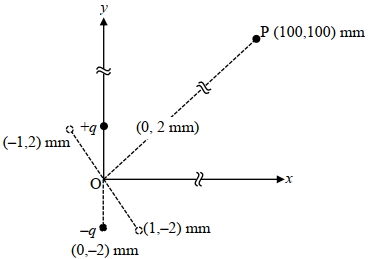
- 3An electric dipole is formed by two charges $+q$ and $-q$ located in xy-plane at $(0,2) \mathrm{mm}$ and $(0,-2) \mathrm{mm}$, respectively, as shown in the figure. The electric potential at point $\mathrm{P}(100,100) \mathrm{mm}$ due to the dipole is $V_0$. The charges $+q$ and $-q$ are then moved to the points $(-1,2) \mathrm{mm}$ and $(1,-2) \mathrm{mm}$, respectively. What is the value of electric potential at $P$ due to the new dipole?View Solution
- 4A parallel plate capacitor with air between the plate has a capacitance of $15 pF$. The separation between the plate becomes twice and the space between them is filled with a medium of dielectric constant $3.5.$ Then the capacitance becomes $\frac{ x }{4}\,pF$.The value of $x$ is $............$View Solution
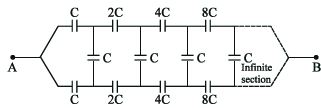
- 5Find the equivalent capacitance of the circuit between point $A$ and $B$.View Solution
- 6In order to obtain a time constant of $10$ seconds in an $RC$ circuit containing a resistance of $10^3\,\Omega,$ the capacity of a condenser should be.....$ \mu F$View Solution
- 7The work which is required to be done to make an arrangement of four particles each having a charge $+q$ such that the particles lie at the four corners of a square of side $a$ is .......View Solution
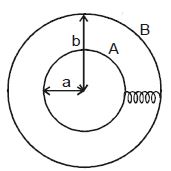
- 8Two spherical conductors $A$ and $B$ of radii $a$ and $b$ $(b > a)$ are placed concentrically in air. The two are connected by a copper wire as shown in figure. Then the equivalent capacitance of the system isView Solution
- 9A force of $10 \; N$ acts on a charged particle placed between two plates of a charged capacitor. If one plate of capacitor is removed, then the force acting on that particle will be ...... $N$View Solution
- 10An electric charge $10^{-6} \mu \mathrm{C}$ is placed at origin $(0,0)$ $\mathrm{m}$ of $\mathrm{X}-\mathrm{Y}$ co-ordinate system. Two points $\mathrm{P}$ and $\mathrm{Q}$ are situated at $(\sqrt{3}, \sqrt{3}) \mathrm{m}$ and $(\sqrt{6}, 0) \mathrm{m}$ respectively. The potential difference between the points $P$ and $Q$ will be :View Solution