MCQ
Two vectors $\overrightarrow A $ and $\overrightarrow B $ are at right angles to each other, when
  • A
    $\overrightarrow A + \overrightarrow B = 0$
  • B
    $\overrightarrow A - \overrightarrow B = 0$
  • C
    $\overrightarrow A \times \overrightarrow B = 0$
  • $\overrightarrow A \,.\,\overrightarrow B = 0$
Answer

Correct option: D.
$\overrightarrow A \,.\,\overrightarrow B = 0$
d
(d) $\vec A.\vec B = \,|\vec A|.|\vec B|.\cos \theta = \vec A.\vec B.\cos 90^\circ = 0$

Need a full question paper?

Generate a complete, print-ready paper with questions like this in minutes — across 16+ boards, with answer keys.

Start Generating Free

Similar questions

Which of the following statements is false for a particle moving in a circle with a constant angular speed
In the diagram, $BAC$ is a rigid fixed rough wire and angle $BAC$ is $60^o$. $P$ and $Q$ are two identical rings of mass $m$ connected by a light elastic string of natural length $2a$ and elastic constant $\frac{mg}{a}$. If $P$ and $Q$ are in equilibrium when $PA = AQ = 3a$ then the least coefficient of friction between the ring and the wire is $\mu$. Then value of $\mu + \sqrt 3 $ is :-
A $U-$ tube in which the cross-sectional area of the limb on the left is one quarter, the limb on the right contains mercury (density $13.6 g/cm^3$). The level of mercury in the narrow limb is at a distance of $36 cm$  from the upper end of the tube. What will be the rise in the level of mercury in the right limb if the left limb is filled to the top with water ........ $cm$
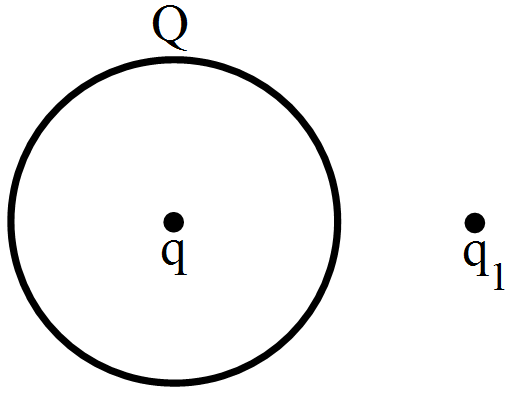
A thin, metallic spherical shell contains a charge $Q$ on it. A point charge $q$ is placed at the centre of the shell and another charge $q_1$ is placed outside it as shown in figure. All the three charges are positive. The force on the charge at the centre is:
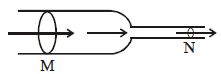
Horizontal tube of non-uniform cross-section has radii of  $0.1\,m$ and  $0.05\,m$ respectively at $M$  and  $N.$  For a stream-line flow of liquid the rate of liquid flow is
Consider two vectors ${\overrightarrow F _1} = 2\hat i + 5\hat k$ and ${\overrightarrow F _2} = 3\hat j + 4\hat k.$ The magnitude of the scalar product of these vectors is
The ratio of specific heats of a gas is $\frac{9}{7}$, then the number of degrees of freedom of the gas molecules for translational motion is :
When red glass is heated in dark room it will seem
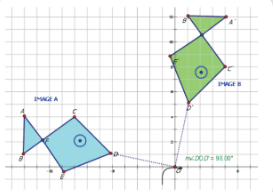
The figure below shows a pattern of two fishes. Write the mapping rule for the rotation of Image A to Image B.
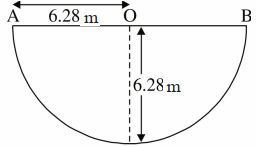
When a particle moving in a circular orbit of radius 6.28 meters reaches from one end of the diameter to the other, then the ratio between the distance covered and the displacement will be :
Image